
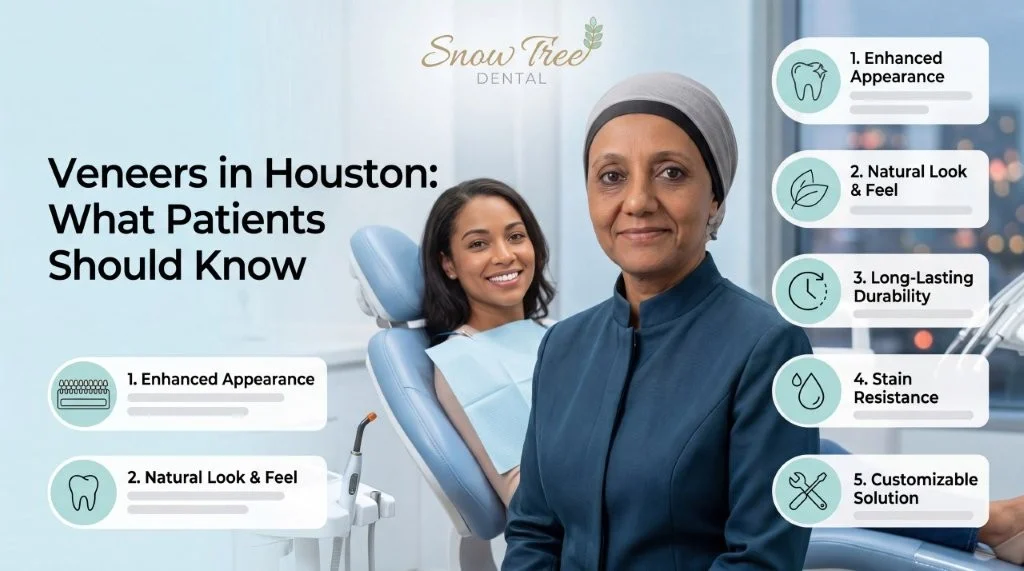
If you have ever looked at your smile in a photo and wished your teeth looked a little brighter, smoother, or more even, you are not alone. Many patients ask about veneers because they want a smile that feels more confident without looking artificial or overdone.
Veneers are a cosmetic dental treatment used to improve the appearance of the front surface of teeth. They may be an option for concerns such as discoloration, small chips, worn edges, uneven tooth shape, or minor gaps. For patients considering veneers in Houston, the most important first step is understanding what veneers can do, what they cannot do, and whether they truly fit your teeth and goals.
At Snow Tree Dental in Houston, cosmetic dentistry in Houston begins with a careful look at your smile, oral health, bite, and expectations. Veneers can be a helpful option for the right patient, but they should never be treated as a one-size-fits-all solution. Teeth have a rude habit of being individual.
What Are Veneers?
Veneers are thin custom coverings placed over the front surface of teeth. They are most often used on visible front teeth to improve the look of a smile. Veneers may be made from different materials, most commonly porcelain or composite resin.
A veneer does not replace the entire tooth. Instead, it changes the visible surface of the tooth by improving color, shape, size, or overall appearance. Depending on the case, a dentist may need to prepare the tooth by removing a small amount of enamel before placing the veneer.
Veneers are often considered when a patient wants to improve cosmetic concerns such as:
- Deep staining or discoloration
- Small chips
- Worn or uneven edges
- Slight gaps between teeth
- Teeth that appear too small
- Irregular tooth shape
- A smile that looks unbalanced
Because veneers are a cosmetic treatment, thoughtful planning matters. The goal should not be to create teeth that look fake, oversized, or too bright. The goal is a smile that fits your face, supports your bite, and feels natural long term.
What Smile Concerns Can Veneers Help With?
Veneers may help with several appearance-related concerns, especially when the front teeth are healthy enough to support them. A consultation helps determine whether veneers are the right approach or whether another treatment should come first.
Stained or Discolored Teeth
Some tooth discoloration responds well to professional teeth whitening. Other stains, especially deeper internal discoloration, may not improve as much with whitening alone. In those situations, veneers may be discussed as a cosmetic option.
A dentist may still recommend whitening before veneers, especially if nearby natural teeth also need to be brightened. This can help the final shade look more balanced and natural.
Small Chips or Worn Edges
Small chips or uneven edges can make teeth look worn, aged, or less symmetrical. Veneers may help create a smoother, more even appearance across the visible teeth.
However, veneers are not always the right choice for every chipped or worn tooth. If a tooth has significant damage, a large filling, or structural weakness, another option such as a crown may be more appropriate.
Minor Gaps or Uneven Tooth Shape
Veneers can sometimes improve the look of small spaces between teeth or teeth that are slightly uneven in shape. They can help create the appearance of better balance across the smile.
That said, veneers do not physically move teeth. If spacing, crowding, or alignment concerns are more significant, Invisalign in Houston or another orthodontic option may be recommended before cosmetic treatment.
Teeth That Look Too Small
Some patients feel their teeth look short, narrow, or out of proportion with their smile. Veneers may help adjust the visible size and shape of teeth when the gum line, enamel, and bite support that type of treatment.
This is where planning becomes especially important. Adding length or width to teeth without considering the whole smile can make the result look bulky or unnatural.
Types of Veneers Houston Patients May Hear About
When researching veneers Houston patients often come across several terms online. Some are useful. Others are marketing language wearing a white coat and hoping nobody asks follow-up questions. Here are the main types patients usually hear about.
Porcelain Veneers
Porcelain veneers are custom-made restorations designed to fit over the front surface of teeth. They are often chosen because they can create a natural-looking appearance and can be designed to reflect light in a way that resembles enamel.
Porcelain veneers usually require more than one visit. The process may include a consultation, smile planning, tooth preparation, temporary veneers in some cases, and final placement.
Porcelain can be a durable cosmetic material, but it still needs proper care. Patients should avoid chewing ice, biting hard objects, or using their teeth as tools. Teeth are not package openers, despite generations of humans trying to prove otherwise.
Composite Veneers
Composite veneers are made from tooth-colored resin material. In some cases, composite can be applied directly to the tooth and shaped during the visit.
Composite may be useful for smaller cosmetic changes or for patients who need a more conservative approach depending on the situation. However, composite and porcelain do not age exactly the same way. Composite may stain or wear differently over time, so maintenance expectations should be discussed before treatment.
No-Prep or Minimal-Prep Veneers
Some patients ask about no-prep or minimal-prep veneers because they sound less invasive. These options may be appropriate in selected cases, but they are not right for every smile.
If teeth are already positioned forward, adding material without preparation can sometimes make them look bulky. A dentist needs to evaluate tooth position, enamel, bite, and desired outcome before recommending this approach.
Are Veneers Right for Everyone?
No. Veneers are not the best option for every patient.
A dentist may recommend treating other issues first if you have:
- Active cavities
- Gum disease
- Weak or limited enamel
- Severe grinding or clenching
- Major bite problems
- Large existing fillings
- Teeth with structural damage
- Unrealistic expectations about the final result
For example, if the gums are inflamed, cosmetic treatment may need to wait until the gums are healthier. If teeth are crowded or rotated, Invisalign may be recommended before veneers. If a tooth is cracked or heavily restored, a crown may offer better support.
A trusted dentist Houston patients visit for cosmetic care should explain these options clearly. The right treatment is not always the most aggressive one, and a good consultation should make that clear.
What Causes Patients to Consider Veneers?
Patients consider veneers for many reasons. Some have been bothered by the same cosmetic concern for years. Others notice changes after aging, grinding, old dental work, staining, or small injuries.
Common reasons include:
- Teeth that no longer respond well to whitening
- Old chips from injuries or wear
- Uneven front teeth
- Small spaces that bother the patient
- Worn edges from grinding
- A smile that looks darker in photos
- Teeth that appear too small or narrow
Sometimes the concern is mostly cosmetic. Other times, the issue is connected to bite problems, enamel wear, gum changes, or older dental work. That is why a veneer consultation should include more than simply choosing a shade from a chart and hoping for the best.
What Happens During a Veneers Consultation?
A veneers consultation should feel informative, not rushed. Before recommending treatment, the dentist should understand what you want to change and whether veneers are the right way to reach that goal.
Smile Goals and Expectations
Your dentist may ask what bothers you most about your smile. Is it the color? Shape? Size? Symmetry? Old chips? Spaces between teeth?
Clear goals help guide the treatment plan. They also help prevent results that look too white, too large, or not quite right for your face. The best cosmetic dentistry should enhance your smile, not erase your personality.
Oral Health Check
The dentist will evaluate your teeth, gums, enamel, bite, and any existing dental work. This step helps determine whether veneers are appropriate and whether other care should come first.
If there are cavities, gum disease, bite concerns, or signs of grinding, those issues may need to be addressed before cosmetic treatment begins.
Shade and Shape Discussion
Natural-looking veneers are not just about choosing the brightest shade. Tooth shape, facial features, gum line, smile width, and neighboring teeth all matter.
A good cosmetic result should look balanced. Most patients want people to notice their smile, not immediately think, “Those are veneers.” Subtlety, rare as it is in modern civilization, matters here.
Treatment Planning
Depending on the case, the dentist may discuss photos, scans, impressions, or a smile preview. The exact process can vary, but the purpose is the same: to plan the size, shape, color, and fit before treatment begins.
This planning stage helps the patient and dentist stay aligned before any final restorations are made.
What to Expect During the Veneers Process
The veneers process usually begins with a consultation and exam. If veneers are recommended, the next steps may include treatment planning, tooth preparation, temporary veneers, and final placement.
A general process may include:
- Consultation and smile evaluation
- Review of treatment options
- Shade and shape planning
- Tooth preparation if needed
- Temporary veneers in some cases
- Final veneer placement
- Bite check and follow-up guidance
Some veneers involve removing a small amount of enamel. This is one reason patients should understand the long-term nature of treatment before moving forward.
After veneers are placed, your dentist will check your bite and make sure the restorations feel comfortable. You will also receive instructions on how to care for them and what habits to avoid.
Do Veneers Look Natural?
Veneers can look natural when they are carefully planned and customized. They can also look fake when they are too bright, too flat, too bulky, or not matched to the patient’s face.
Natural-looking veneers depend on:
- Tooth color
- Shape and length
- Translucency
- Gum line
- Smile width
- Facial features
- Bite position
- Surrounding natural teeth
The best cosmetic dentistry often looks effortless. That does not happen by accident. It comes from planning, communication, and choosing a result that fits the person rather than chasing the same copy-paste smile seen all over the internet.
How to Care for Veneers
Veneers need daily care, just like natural teeth. The teeth underneath and the surrounding gums still need to stay healthy.
Helpful habits include:
- Brush twice daily
- Floss every day
- Keep regular dental checkups
- Avoid chewing ice or hard objects
- Do not use your teeth to open packages
- Wear a nightguard if recommended
- Address grinding or clenching
- Limit habits that can stain natural teeth around veneers
Veneers are strong, but they are not indestructible. If a veneer chips, feels loose, or your bite feels different, call your dentist.
When Should You Call a Dentist About Veneers?
You may want to schedule a veneers consultation if you feel unhappy with the appearance of your front teeth and want to understand your options.
Call a dentist if you notice:
- Visible chips or worn edges
- Stains that do not improve with whitening
- Uneven tooth shape
- Small gaps that bother you
- Teeth that look too short or small
- Old cosmetic bonding that no longer looks good
- A smile that feels unbalanced
- Concerns before a major event or photo-heavy occasion
You should also call if you already have veneers and notice sensitivity, rough edges, looseness, chips, or discomfort when biting. Small changes can be easier to manage when they are checked early.
Practice Experience: What We Often Hear From Patients
At Snow Tree Dental, many veneer conversations begin with patients saying they want their smile to look better but still look like themselves. Some are concerned about old chips, uneven edges, discoloration, or teeth that look small in photos. A realistic consultation helps patients understand what veneers can improve, what they cannot change, and whether another treatment should come first for a healthier, more natural result.
Veneers vs. Other Cosmetic Dental Options
Veneers are only one option. A good cosmetic plan may include a different treatment or a combination of treatments, depending on your goals and oral health.
Veneers vs. Teeth Whitening
Whitening changes tooth color. Veneers can change the visible color, shape, and size of teeth.
If your main concern is yellowing or surface stains, whitening may be discussed first. If your concern includes shape, chips, or deep discoloration, veneers may be considered.
Veneers vs. Bonding
Bonding uses tooth-colored resin to repair or reshape part of a tooth. It may be useful for small chips or minor cosmetic changes.
Veneers may be considered when a patient wants a broader cosmetic change across several visible teeth.
Veneers vs. Invisalign
Invisalign helps move teeth into better alignment. Veneers change the appearance of the front surface of teeth.
If teeth are crowded, rotated, or spaced in a way that affects the bite, Invisalign may be recommended before veneers.
Veneers vs. Crowns
A veneer covers the front surface of a tooth. A crown covers more of the tooth and may be recommended when the tooth needs more structural support.
If a tooth is heavily damaged, cracked, or already has a large filling, a crown may be a better option than a veneer.
Myth vs. Fact About Veneers
Myth: Veneers always look fake.
Fact: Veneers can look natural when they are carefully designed for the patient’s face, gum line, tooth shape, and smile goals.
Myth: Everyone needs a full set of veneers.
Fact: The number of veneers depends on your smile, visible teeth, and goals. Some patients only need a few. Others may benefit from a broader plan.
Myth: Veneers fix every dental problem.
Fact: Veneers are cosmetic. They do not treat cavities, gum disease, severe bite problems, or major tooth damage.
Myth: The whitest shade is always best.
Fact: A natural-looking shade is often more flattering than the brightest possible shade. Teeth are not bathroom tile, even though the internet occasionally tries to convince everyone otherwise.
Questions to Ask Before Choosing Veneers
Before starting treatment, ask your dentist:
- Am I a good candidate for veneers?
- Do I need whitening, bonding, Invisalign, or crowns instead?
- Will enamel need to be removed?
- How many veneers do you recommend?
- What shade will look natural?
- How will the shape and size be planned?
- What should I expect during treatment?
- How do I care for veneers long term?
- What should I do if I grind my teeth?
For additional patient education, you can review the American Dental Association overview of veneers before your consultation.
FAQ About Veneers in Houston
1. What are veneers?
Short answer: Veneers are thin custom coverings placed over the front surface of teeth to improve their appearance.
Veneers may help with cosmetic concerns such as discoloration, small chips, worn edges, uneven tooth shape, or minor gaps. They are most often used on visible front teeth and may be made from porcelain or composite resin. A dentist should evaluate your teeth, gums, enamel, and bite before recommending veneers.
2. Who is a good candidate for veneers?
Short answer: A good candidate usually has healthy teeth and gums, enough enamel, and realistic cosmetic goals.
Veneers may be a good option if you want to improve the look of stained, chipped, worn, uneven, or slightly spaced front teeth. They may not be recommended if you have active cavities, gum disease, severe grinding, weak enamel, or major bite problems. In those cases, your dentist may suggest treating those issues first or considering another option.
3. Are veneers permanent?
Short answer: Many veneers are considered a long-term commitment because some enamel may need to be removed.
Not every case is the same, but traditional veneers often involve preparing the teeth so the veneers can fit properly and look natural. Since enamel does not grow back, patients should understand the treatment plan before moving forward. Your dentist can explain whether preparation is needed in your case.
4. Do veneers look natural?
Short answer: Veneers can look natural when they are carefully planned and customized.
Natural-looking veneers depend on more than shade. Tooth shape, size, gum line, smile width, facial features, and surrounding teeth all matter. The goal should be a balanced smile that fits your face, not teeth that look too white, bulky, or artificial.
5. What is the difference between porcelain and composite veneers?
Short answer: Porcelain veneers are custom restorations, while composite veneers use tooth-colored resin material.
Porcelain veneers are usually made outside the mouth and placed during a later visit. Composite veneers may sometimes be shaped directly on the tooth. Each material has different appearance, maintenance, and wear considerations. Your dentist can help you compare which option fits your smile goals and oral health.
6. Can veneers fix gaps between teeth?
Short answer: Veneers may improve the look of small gaps, but they do not actually move teeth.
If the spaces are minor and the bite is healthy, veneers may help create a more even-looking smile. If the gaps are larger or related to tooth position, Invisalign or another orthodontic option may be recommended before veneers. A consultation helps determine which approach is more appropriate.
7. Are veneers better than teeth whitening?
Short answer: Not always. Whitening may be better for color concerns, while veneers can address color, shape, and size.
If your main concern is surface staining or yellowing, professional teeth whitening may be discussed first. Veneers may be considered when discoloration is deeper or when you also want to change tooth shape, size, chips, or uneven edges. The right choice depends on what you want to improve.
8. How many veneers do I need?
Short answer: The number of veneers depends on your smile goals, visible teeth, bite, and tooth shape.
Some patients only consider one or two veneers for specific teeth. Others may benefit from treating several visible teeth to create a more balanced smile. Your dentist can help you decide what looks natural and fits your overall treatment plan.
9. Do veneers hurt?
Short answer: Veneer treatment should be planned with patient comfort in mind, but the experience can vary.
Some cases involve little or no tooth preparation, while others require more planning and preparation. Your dentist can explain what to expect based on the type of veneer, the condition of your teeth, and your treatment plan. If comfort is a concern, bring it up during the consultation.
10. How do I care for veneers?
Short answer: Care for veneers by brushing, flossing, keeping dental visits, and avoiding habits that can damage them.
Veneers still rely on healthy teeth and gums underneath. Daily brushing, daily flossing, and regular dental checkups are important. Avoid chewing ice, biting hard objects, or using your teeth to open packages. If you grind or clench your teeth, your dentist may recommend a nightguard.
11. When should I call a dentist about veneers?
Short answer: Call a dentist if you are unhappy with chips, stains, uneven teeth, small gaps, or old cosmetic work.
You should also call if you already have veneers and notice sensitivity, rough edges, looseness, chips, or discomfort when biting. For patients considering veneers in Houston, a consultation at Snow Tree Dental can help clarify whether veneers or another cosmetic option makes the most sense.
12. What do patients usually ask about veneers at Snow Tree Dental?
Short answer: Many patients ask whether veneers will look natural, how many teeth need treatment, and whether another option should come first.
At Snow Tree Dental, veneer consultations often begin with patients saying they want their smile to look better but still feel like their own. Some ask about old chips, uneven edges, discoloration, or teeth that look small in photos. A realistic consultation helps patients understand what veneers can improve, what they cannot change, and whether whitening, bonding, Invisalign, crowns, or veneers would create the healthiest and most natural-looking result.
Conclusion: Veneers Can Be Helpful, But Planning Matters
Veneers can be a helpful cosmetic option for patients who want to improve the appearance of visible teeth. They may help with chips, discoloration, worn edges, uneven shape, or minor gaps, but they are not right for every situation.
The best results start with a healthy foundation, realistic goals, and a dentist who explains your options clearly. At Snow Tree Dental in Houston, patients can discuss their smile concerns, ask questions, and learn whether veneers or another cosmetic treatment makes the most sense.
If you are considering veneers in Houston, schedule a cosmetic consultation with Snow Tree Dental. Our team can review your smile goals, evaluate your teeth and gums, and help you understand whether veneers or another cosmetic option makes the most sense for you.