
Hearing that you may need a tooth extraction can feel stressful, especially if you are already dealing with pain, swelling, or a broken tooth. Many patients worry about what the procedure will feel like, how long recovery will take, and whether removing the tooth is really necessary.
A tooth extraction is not about rushing to remove a tooth. In most cases, the first step is understanding what is happening and whether the tooth can still be saved. When a tooth is too damaged, infected, loose, or difficult to restore, removal may be the safest way to protect your comfort and overall oral health.
At Snow Tree Dental in Houston, patients often come in with urgent questions about tooth pain, wisdom teeth, infection, or broken teeth. This guide explains why a tooth extraction may be recommended, what to expect during the visit, how recovery usually works, and when it is time to call a dentist.
What Is a Tooth Extraction?
A tooth extraction is a dental procedure that removes a tooth from its socket in the jawbone. It may be recommended when keeping the tooth could lead to ongoing pain, infection, bite problems, or other oral health concerns.
That does not mean every painful tooth needs to be removed. A dentist will usually examine the tooth, review your symptoms, take X-rays when needed, and check the surrounding gums and bone before recommending treatment. In many cases, a filling, dental crown, root canal, or gum treatment may still be possible.
There are also different types of extractions. A simple extraction may be used when the tooth is visible and can be removed without more complex steps. A surgical extraction may be needed if the tooth is broken, impacted, partially erupted, or more difficult to access. Your dentist should explain which type applies to your situation and why.
For general patient education, you can also review tooth extraction information from the American Dental Association.
Common Reasons Patients Need a Tooth Extraction
Tooth removal is usually recommended for a clear reason. Understanding the cause can make the decision feel less confusing and more manageable.
Severe Tooth Decay
When tooth decay is small or moderate, a filling or crown may be enough to repair the tooth. But if decay has destroyed too much healthy structure, the tooth may no longer be strong enough to support a restoration.
In that situation, extraction may be recommended to remove the damaged tooth and reduce the risk of continued pain or infection.
Dental Infection or Abscess
A dental infection can develop when bacteria reach the inside of the tooth or spread near the root. Symptoms may include throbbing pain, swelling, sensitivity, a bad taste, or drainage near the gum.
Some infected teeth can be treated with root canal therapy. Others may be too damaged to save. The right choice depends on the condition of the tooth, the amount of remaining structure, and whether the infection can be treated predictably.
Broken or Cracked Tooth
A tooth can break from an injury, biting something hard, grinding, old dental work, or deep decay. Small chips or cracks may be repairable. A deeper crack, especially one that extends below the gumline, can make the tooth difficult or impossible to restore.
If the tooth is split, severely broken, or painful when biting, your dentist may discuss extraction as one possible solution.
Advanced Gum Disease
Gum disease can damage the bone and tissue that support the teeth. Over time, a tooth may become loose or unstable. When there is not enough support left to keep the tooth healthy and functional, removal may be part of a larger plan to protect the rest of the mouth.
Wisdom Tooth Problems
Wisdom teeth can cause pain, swelling, gum irritation, crowding, or cleaning problems. Some wisdom teeth only come in partway, creating spaces where food and bacteria can collect.
Not every wisdom tooth needs to be removed. But if a wisdom tooth is painful, infected, hard to clean, or affecting nearby teeth, it should be evaluated by a dentist.
Orthodontic or Restorative Planning
Sometimes a tooth extraction is part of a broader treatment plan. For example, removal may be considered before orthodontic treatment, dentures, implant planning, or other restorative care.
In these cases, the extraction is not only about removing a problem tooth. It may be part of creating better function, spacing, or long-term stability.
Signs You Should Call a Dentist in Houston
If you are searching for tooth extraction Houston options, there is a good chance something already feels uncomfortable or urgent. While only a dentist can tell you whether extraction is needed, certain symptoms should not be ignored.
Call a dentist if you notice:
- Severe or worsening tooth pain
- Swelling around the gums, jaw, or face
- A broken tooth with pain or sharp edges
- Pain when biting or chewing
- A loose adult tooth
- Bad taste or drainage near a tooth
- Wisdom tooth pain or swelling in the back of the mouth
- A tooth that has darkened after an injury
- Gum swelling that keeps coming back
If pain, swelling, or a broken tooth feels urgent, scheduling with an emergency dentist in Houston can help you find out whether the tooth can be saved or whether removal may be needed.
Some symptoms may need urgent medical attention. If you have facial swelling, trouble breathing, trouble swallowing, fever with swelling, or symptoms that seem to be spreading quickly, seek emergency medical care. Dental infections can become serious, and waiting for them to magically behave is not a strategy, despite humanity’s long relationship with denial.
Does Every Problem Tooth Need to Be Removed?
No. Tooth extraction is not always the first or only option.
Depending on the tooth, your dentist may discuss treatments such as:
- Fillings for smaller cavities
- Dental crowns for weakened or broken teeth
- Root canal therapy for certain infected teeth
- Gum treatment for periodontal problems
- Bite adjustment or protection for teeth affected by grinding
In some cases, root canal treatment may help save an infected tooth instead of removing it.
The decision depends on several factors, including how much healthy tooth structure remains, whether infection is present, how strong the surrounding bone and gums are, and whether the tooth can function comfortably after treatment.
A trustworthy dentist Houston patients can rely on should explain the reasoning behind the recommendation. You should feel comfortable asking whether the tooth can be saved, what the alternatives are, and what may happen if treatment is delayed.
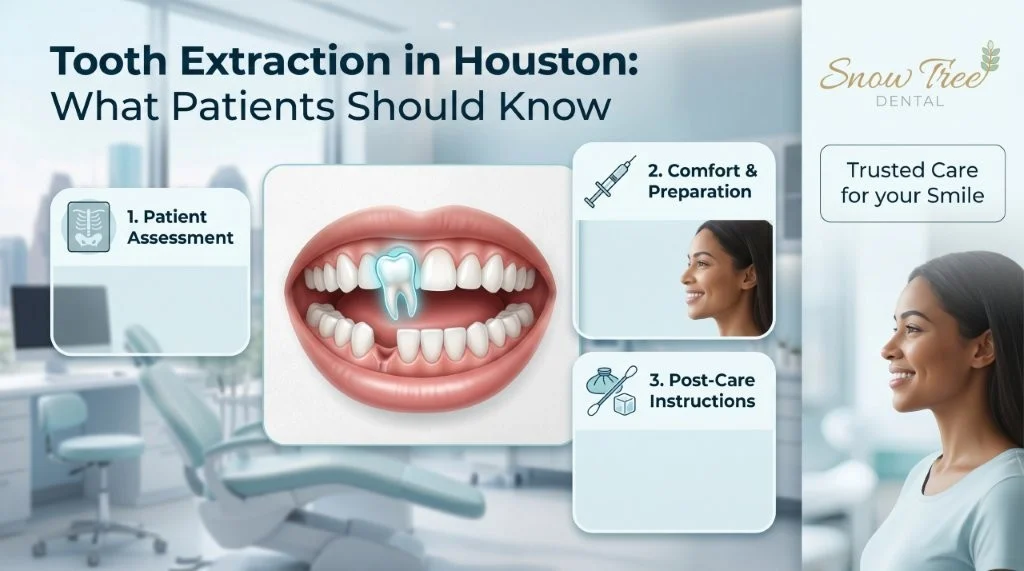
What to Expect During a Tooth Extraction Appointment
Knowing what happens during the visit can make the process feel less overwhelming. Most patients feel better once they understand the steps.
Exam and X-rays
Your dentist will examine the tooth and the surrounding area. X-rays may be taken to look at the roots, bone, infection, or the position of the tooth. This helps the dentist determine whether the extraction is likely to be straightforward or more involved.
Your dentist may also review your medical history and any medications you take. This is important because certain health conditions or medications can affect healing, bleeding, or treatment planning.
Numbing the Area
Before the tooth is removed, the area is numbed with local anesthesia. You should not feel sharp pain during the extraction, though you may feel pressure or movement.
If you feel anxious, tell the dental team before the procedure begins. A clear explanation of what to expect can help you feel more in control during the visit.
Removing the Tooth
The exact process depends on the tooth. A visible tooth may be gently loosened and removed. A broken, impacted, or more difficult tooth may require a more involved approach.
Your dental team should keep you informed without overwhelming you with unnecessary details. Most patients want reassurance and clarity, not a dramatic documentary about the tooth’s final act.
Aftercare Instructions
After the extraction, you will receive instructions to help protect the area while it heals. These may include how to use gauze, what foods to eat, what activities to avoid, and when to call the office.
Follow the instructions from your dentist closely. Your specific situation matters, and aftercare is not the part where improvisation becomes impressive.
Tooth Extraction Recovery: What Patients Should Know
Recovery varies from person to person. The type of tooth, the difficulty of the extraction, your overall health, and how well you follow aftercare instructions can all affect healing.
Most patients should expect some soreness or tenderness after the procedure. This is normal, but your symptoms should gradually improve.
Helpful recovery habits may include:
- Resting after the appointment
- Eating soft foods at first
- Avoiding hard, crunchy, or spicy foods until advised
- Drinking plenty of water
- Keeping the area clean as directed
- Avoiding smoking or vaping during early healing
- Avoiding straws if your dentist tells you to
- Taking recommended or prescribed medication exactly as directed
Some light bleeding early on can be normal. Swelling or soreness may also happen. However, pain that gets worse after a few days, heavy bleeding, fever, increasing swelling, or a bad taste that does not improve should be reported to your dentist.
If you are unsure whether something is normal, call the office. It is better to ask than to guess, especially when healing tissue is involved and the internet is doing what it does best: creating panic in bulk.
What Is Dry Socket?
Dry socket is a possible complication after a tooth extraction. It can happen when the protective blood clot at the extraction site becomes dislodged, dissolves too early, or does not form properly.
That clot plays an important role in healing. It protects the bone and nerves underneath while the area begins to recover. If the clot is lost too soon, the area can become more painful instead of less painful.
Patients with dry socket may notice stronger pain a few days after the extraction. Some may also notice a bad taste or odor. Dry socket does not happen to every patient, but it is one reason aftercare instructions matter.
If pain increases instead of improving, call your dentist. Do not try to diagnose or treat it on your own.
Replacing a Tooth After Extraction
After some extractions, your dentist may recommend replacing the missing tooth. This depends on which tooth was removed, your bite, your oral health, and your long-term goals.
A missing tooth can sometimes affect chewing, spacing, appearance, and bite balance. Over time, nearby teeth may shift into the open space, depending on the location and situation.
Replacement options may include:
- Dental implants
- Dental bridges
- Partial dentures
- Full dentures when appropriate
Wisdom teeth usually do not need to be replaced. Other teeth may require a more detailed discussion. Your dentist can explain whether replacement is recommended and which options may fit your needs.
If the extracted tooth needs to be replaced, Snow Tree Dental can explain options such as dental implants in Houston, bridges, or dentures based on your oral health and goals.
Myth vs. Fact: Tooth Extraction
Myth: If a tooth hurts badly, it always needs to be removed.
Fact: Severe pain can come from different causes. Some teeth can be treated with root canal therapy, crowns, or other dental care. An exam is needed before deciding.
Myth: Tooth extraction means you do not need follow-up care.
Fact: Aftercare matters. Your dentist may need to check healing or discuss tooth replacement options, depending on the tooth that was removed.
Myth: It is better to wait until the pain becomes unbearable.
Fact: Waiting can make treatment more complicated. Early evaluation gives you more options and may help prevent the problem from getting worse.
Myth: Every missing tooth must be replaced immediately.
Fact: Some teeth, such as wisdom teeth, are often not replaced. Other missing teeth may need replacement planning to help protect chewing, spacing, and bite balance.
Experience From Patient Care at Snow Tree Dental
At Snow Tree Dental, many patients come in worried that a tooth extraction will be painful, complicated, or embarrassing. Often, they have been trying to manage tooth pain for days or weeks before finally making an appointment. A helpful visit starts with listening, taking the right images, explaining whether the tooth can be saved, and reviewing aftercare before the patient leaves. That kind of step-by-step communication can make the experience feel more manageable and less intimidating.
Questions to Ask Before a Tooth Extraction
Before treatment, it is completely reasonable to ask questions. A clear conversation can help you feel prepared and confident about your next step.
Good questions include:
- Can this tooth be saved?
- What are my other treatment options?
- Is this a simple or surgical extraction?
- What should I do before the appointment?
- What should I avoid after the extraction?
- How should I manage discomfort at home?
- What symptoms should make me call the office?
- Will I need to replace this tooth later?
- When can I return to normal eating and brushing?
You do not need to know dental terminology to have a useful conversation. You only need clear answers in plain language.
When to Call Snow Tree Dental
You should call Snow Tree Dental if you have tooth pain, swelling, a broken tooth, a loose adult tooth, or wisdom tooth discomfort. You should also schedule an exam if another dentist told you that a tooth may need to be removed and you want to better understand your options.
If you have tooth pain, swelling, a broken tooth, or have been told you may need a tooth extraction, schedule an exam with Snow Tree Dental in Houston. The team can evaluate the tooth, explain whether it can be saved, and guide you through the next step with clear, practical care.
FAQ Section: Tooth Extraction in Houston
1. How do I know if I need a tooth extraction?
Short answer: You may need a tooth extraction if a tooth is badly damaged, infected, very loose, or causing repeated pain or swelling.
A dentist needs to examine the tooth and may take X-rays to see whether it can be saved. In some cases, a filling, crown, root canal, or gum treatment may still be possible. If the tooth cannot be restored safely or predictably, extraction may be recommended.
2. Is tooth extraction painful?
Short answer: The area is numbed before the tooth is removed, so you should not feel sharp pain during the procedure.
You may feel pressure or movement during the extraction. After the appointment, some soreness or tenderness is common. Your dentist will give you aftercare instructions to help you manage healing and know what symptoms should be reported.
3. When should I call a dentist in Houston about tooth pain?
Short answer: Call a dentist if you have severe pain, swelling, a broken tooth, a loose adult tooth, or pain that keeps coming back.
Tooth pain can come from decay, infection, cracks, gum disease, or wisdom tooth problems. If you also have facial swelling, trouble swallowing, trouble breathing, fever with swelling, or symptoms that seem to be spreading quickly, seek urgent medical care.
4. Can a tooth be saved instead of extracted?
Short answer: Sometimes, yes. Not every painful or damaged tooth needs to be removed.
Depending on the condition of the tooth, your dentist may discuss options such as a filling, dental crown, root canal treatment, or gum treatment. Extraction is usually considered when the tooth cannot be repaired in a stable, healthy, or predictable way.
5. What are common reasons for tooth extraction?
Short answer: Common reasons include severe decay, infection, broken teeth, advanced gum disease, and wisdom tooth problems.
A tooth may also need to be removed if it is too loose, deeply cracked, impacted, or part of a larger treatment plan. The reason matters because it helps your dentist decide whether removal or another treatment option is more appropriate.
6. What should I expect during a tooth extraction appointment?
Short answer: Your dentist will examine the tooth, review X-rays if needed, numb the area, remove the tooth, and give you aftercare instructions.
The exact process depends on the tooth and whether the extraction is simple or more involved. Your dental team should explain what is happening before treatment starts so you know what to expect and feel more prepared.
7. How long does recovery take after a tooth extraction?
Short answer: Recovery varies depending on the tooth, the type of extraction, your health, and how closely you follow aftercare instructions.
Some soreness, swelling, or light bleeding can happen early on. Symptoms should generally improve over time. If pain gets worse after a few days, swelling increases, bleeding seems heavy, or you notice a bad taste that does not improve, call your dentist.
8. What should I avoid after a tooth extraction?
Short answer: Follow your dentist’s instructions, but you may be told to avoid straws, smoking, vaping, hard foods, crunchy foods, and aggressive rinsing during early healing.
These precautions help protect the extraction site while it begins to heal. Your dentist may also recommend soft foods, rest, and careful cleaning around the area. Aftercare is not the part where creativity needs to shine.
9. What is dry socket after tooth extraction?
Short answer: Dry socket can happen when the protective blood clot at the extraction site is lost too early or does not form properly.
This clot helps protect the bone and nerves underneath while healing begins. If the area becomes exposed, pain may increase a few days after the extraction. If pain gets worse instead of better, contact your dentist.
10. Do I need to replace a tooth after extraction?
Short answer: It depends on which tooth was removed and how it affects your bite, chewing, and appearance.
Wisdom teeth usually do not need to be replaced. Other teeth may need replacement options such as dental implants, bridges, partial dentures, or full dentures when appropriate. Your dentist can explain what makes sense for your situation.
11. Can I wait if my tooth pain comes and goes?
Short answer: It is better not to ignore tooth pain that keeps returning, even if it temporarily improves.
Pain that comes and goes can still be related to decay, infection, a crack, gum disease, or bite pressure. An exam can help determine whether the tooth can be treated early or whether tooth extraction may need to be considered.
12. What should I ask before getting a tooth extraction?
Short answer: Ask whether the tooth can be saved, what the alternatives are, what recovery involves, and whether the tooth should be replaced later.
Good questions include whether the extraction is simple or surgical, what symptoms should make you call the office, and when you can return to normal eating and brushing. Clear answers can make the decision feel less stressful.
Practice Experience Note
At Snow Tree Dental, many tooth extraction conversations start with a patient who has been dealing with pain, swelling, or a broken tooth longer than they hoped. A helpful visit usually begins with listening, taking the right images, explaining whether the tooth can be saved, and giving clear aftercare instructions before the patient leaves. That calm, step-by-step approach helps patients understand the recommendation instead of feeling rushed.
Conclusion: Tooth Extraction Care in Houston
A tooth extraction is not always the first choice, but when a tooth cannot be safely restored, removing it may help protect your comfort and oral health. The most important step is getting a clear diagnosis from a dentist who can explain whether the tooth can be saved, what treatment options exist, and what to expect during recovery.
If you have tooth pain, swelling, a broken tooth, or have been told you may need a tooth extraction, schedule an exam with Snow Tree Dental in Houston. The team can evaluate the tooth, explain whether it can be saved, and guide you through the next step with clear, practical care.