
Dental Implants Houston: Are You a Candidate? Steps & Timeline
Dental Implants in Houston: Candidacy, Process, and Recovery Timeline
If you’re exploring dental implants in Houston, you likely want straightforward answers: Am I a candidate? What are the steps? How long will recovery take? This clear, practical guide from a calm, patient-first team near the Galleria walks you through every stage so you can feel informed and at ease.
What Are Dental Implants?
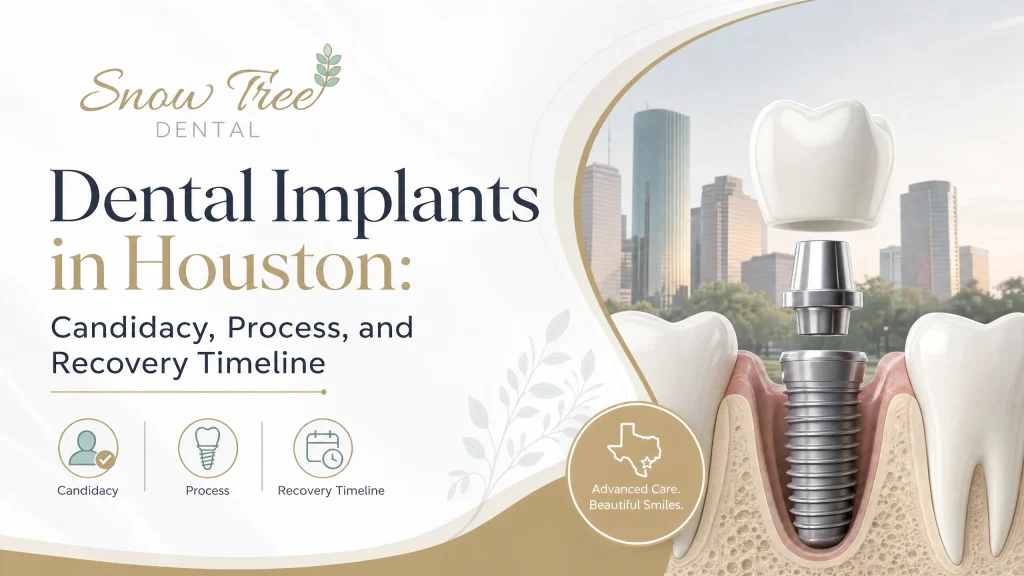
Dental implants are small, biocompatible posts that act like artificial tooth roots. They support a crown, bridge, or denture to replace missing teeth. By restoring the root as well as the tooth above the gumline, implants help you chew comfortably and support the jawbone in the area where a tooth was lost.
Core steps at a glance:
- Consultation and imaging to evaluate candidacy
- Implant placement under local anesthesia
- Initial healing and osseointegration (bone bonding)
- Abutment placement after healing
- Final crown or restoration placement
- Ongoing implant aftercare and routine checkups
Single Implant vs. Other Missing Tooth Options
- Single implant with crown: Replaces one missing tooth without modifying neighboring teeth. Often the most conservative, long-term approach for a single space.
- Traditional bridge: Uses the teeth on either side of the gap as anchors for a fixed bridge—helpful if those teeth already need crowns.
- Partial denture: A removable option that clips to remaining teeth. Typically more affordable upfront, though bulkier and often higher-maintenance.
How Implants Protect Your Smile Long‑Term
- Preserve bone volume: Implants stimulate the bone where a root used to be, helping reduce the “sunken” look that can develop over time.
- Maintain spacing and bite: Filling the space helps prevent drifting teeth and bite changes.
- Support natural chewing: Once fully integrated and restored, a single implant can feel stable and comfortable for everyday eating.
Who Is a Candidate for Dental Implants in Houston?
Many adults in good general and oral health qualify for implants. Your implant dentist will review your medical history and use imaging to confirm your readiness and plan the specifics.
Health and Bone Factors Your Implant Dentist Evaluates
- Jawbone volume and density: Adequate bone is essential for a secure implant. If bone is thin or missing, grafting can often rebuild the site.
- Gum health: Healthy gums are key to long-term implant stability. Active gum disease usually needs care first.
- Bite and spacing: Proper alignment and enough space are important to place the implant and craft a crown that functions well.
Smoking, Gum Health, and Medical Conditions
- Smoking and vaping: Nicotine can affect healing. Even a temporary pause can help; your dentist will guide you on timing and support.
- Medical conditions: Many well-managed conditions, such as diabetes, are compatible with implants. Your dental and medical teams can coordinate as needed.
- Medications: Certain medications—such as some bone or blood-thinning therapies—may influence planning and timing.
Not an Immediate Candidate? Pre‑Treatment Options
- Bone grafting: Adds or rebuilds bone, especially useful after long-standing tooth loss or extractions.
- Periodontal therapy: Treats gum disease to create a healthy foundation.
- Timing after extraction: In some cases, an implant can be placed immediately; in others, a short healing period is best. Your plan is tailored to your specific site and health.
The Dental Implant Process: Step by Step
Consultation and 3D Imaging
- Comprehensive exam, discussion of your goals, and a full health review
- Low‑radiation digital X‑rays and often 3D imaging to map bone, nerves, and sinus anatomy for precise planning
- A clear, written treatment plan and realistic timeline options explained in everyday language
Implant Placement (Comfort and Local Anesthesia)
- The procedure is typically completed with local anesthesia to numb the area
- You may notice gentle pressure and vibration, but not sharp pain
- Sedation options can be discussed if you’re anxious
- A small cover or healing cap protects the site as recovery begins
Healing and Osseointegration
- Over the next several weeks to months, bone bonds naturally to the implant surface
- You’ll return for brief check-ins to confirm comfortable, steady healing
Abutment and Crown for a Single Implant
- When the implant is stable, an abutment (connector) is attached
- A custom crown is designed to match your bite and shade for a natural look
- After a short adjustment period, many patients say the new tooth feels like part of their smile
Timelines: Immediate, Early, and Conventional Approaches
- Immediate: In select cases, an implant and a temporary tooth can be placed the same day
- Early: The implant is placed; after several weeks of healing, the abutment and crown follow
- Conventional: The implant heals for a few months before abutment and crown placement
Your dentist will recommend the approach that balances safety, function, and aesthetics for your specific case.
Implant Recovery: What to Expect Week by Week
First 24–72 Hours (Comfort Tips and Normal Symptoms)
- Mild swelling, minor oozing, and localized soreness are common
- Use cold compresses in short intervals during the first 24 hours
- Take prescribed or recommended over-the-counter pain relief as directed
- Favor cool, soft foods; avoid very hot liquids the first day
- Skip straws and smoking; avoid vigorous rinsing or spitting on day one
1–2 Weeks (Stitches, Soft Foods, Oral Hygiene)
- Swelling and tenderness typically decrease significantly
- Stitches may dissolve on their own or be removed during a quick visit
- Stick to soft foods (yogurt, eggs, mashed potatoes, well‑cooked pasta) and chew away from the site
- Brush gently and begin warm saltwater rinses after 24 hours; avoid brushing directly on the surgical site until cleared by your dentist
1–3 Months (Osseointegration and Follow‑Ups)
- Bone bonding progresses beneath the surface
- Most daily activities—including light exercise—feel normal
- Short follow‑up visits confirm stable healing ahead of the abutment and crown phase
After Crown Placement (Returning to Normal Chewing)
- Gradually return to a full diet as comfort allows
- Minor bite adjustments may fine‑tune contact and comfort
- Keep up with implant aftercare to protect your investment long term
Myth vs. Fact: Implant Recovery
- Myth: “Recovery knocks me out for weeks.” Fact: Most people feel notably better within a few days and return to normal routines quickly, with gradual chewing upgrades over the following weeks.
- Myth: “Implants always hurt.” Fact: With local anesthesia and gentle techniques, most patients report pressure more than pain during placement and manageable soreness afterward.
- Myth: “I can skip checkups once the crown is on.” Fact: Regular checkups and cleanings help protect the gums and maintain implant health.
For additional background, see the American Dental Association overview of dental implants.
Implant Aftercare and Long‑Term Maintenance
Daily Hygiene and Tools
- Brush twice daily with a soft toothbrush; an electric brush can help with thoroughness
- Clean between teeth daily with floss, interproximal brushes, or a water flosser recommended for implants
- Choose a non‑abrasive toothpaste to protect your crown’s surface
Foods, Habits, and Nightguards
- Limit very sticky or hard foods, especially while healing
- Avoid chewing ice or using teeth as tools
- If you clench or grind, a custom nightguard can protect your implant crown and natural teeth
Checkups, Cleanings, and Digital X‑rays
- Maintain routine checkups and professional cleanings as advised
- Low‑radiation digital X‑rays are taken periodically to monitor the bone around your implant
- Let your dental team know if you notice new tenderness, bleeding, or changes
Real‑World Experience from Our Houston Team
At our Houston practice near the Galleria, a typical single‑implant journey might look like this: a patient arrives with a cracked molar that can’t be saved. We plan the extraction and implant together, using digital X‑rays and an intraoral camera to walk them through what we’re seeing. During a calm, numbed appointment, they’re often surprised that the pressure is the oddest sensation—not pain. Within a few days, they feel back to normal, and we schedule brief evening follow‑ups to fit their commute. When the final crown goes in, they’re relieved to chew comfortably on that side again.
When Dental Implants Aren’t the Best Fit
Bridges and Partial Dentures as Missing Tooth Options
- Dental bridge: A fixed, natural‑looking solution that can be ideal when neighboring teeth already need crowns
- Partial denture: A removable option that replaces several teeth at once and can be adjusted over time
Timing and Budget Considerations
- If you’re not ready for implants now, a bridge or partial denture can be a practical interim or long‑term answer
- Your dentist can map out phased care—such as grafting now and an implant later—to match your timeline and comfort
Your Next Step with a Houston Implant Dentist
What to Bring to Your Consultation
- A list of medications and health conditions
- Any recent dental X‑rays or records (if available)
- Questions about missing tooth options, implant recovery, and timeline
Insurance, Membership, and Scheduling Convenience
- Most PPO insurance is accepted, and our team files claims for you
- No insurance? Our in‑house membership (from $225/year) includes exams, cleanings, X‑rays, fluoride, and up to 20% off other services, including implant‑related care
- Evening and Saturday hours help you avoid Houston traffic, and same‑day emergency appointments are available for urgent issues
- Our trilingual team (English, Spanish, Arabic), led by Dr. Muna Mohammed, makes care accessible and comfortable for more families
Choosing a Provider in Houston
When you compare implant dentists, look for clear communication, modern imaging, and a supportive team you trust. For deeper reading before you visit, explore our in‑depth guides: Dental Implants in Houston: Procedure, Recovery, and Who’s a Good Candidate and Dental Implants in Houston: Step‑by‑Step Process, Healing, and Maintenance. When you’re ready to meet a welcoming dentist in Houston, you can reach Snow Tree Dental anytime or learn more about us at Snow Tree Dental.
Image suggestion (for your page builder): Patient reviewing 3D imaging with the dentist
Alt text: dental implants Houston consultation with 3D imaging
Quick Answers
How do I know if I’m a candidate?
Healthy gums, sufficient bone, and good overall health are key. Your implant dentist confirms with an exam and imaging.
How long is recovery?
Most people feel noticeably better within a few days. Bone bonding typically takes a few months before the final crown is placed.
What if I only need one tooth replaced?
A single implant with a custom crown is a conservative, long‑term option that doesn’t depend on neighboring teeth.
Where We Are and How to Reach Us
Snow Tree Dental is conveniently located near the Galleria at 2400 Augusta Dr in Houston, TX. If you’re looking for a friendly, modern implant dentist, we’re here with calm guidance and flexible scheduling. Call (832) 464‑3368 or visit Snow Tree Dental to schedule.
Conclusion: Dental Implants in Houston—Candidacy, Process, and Recovery Timeline Recap
Dental implants Houston patients choose often follow a straightforward path: a thoughtful consultation with imaging, a comfortable placement visit under local anesthesia, steady healing over a few weeks to months, and a custom crown that restores natural chewing. Not everyone is an immediate candidate, but options like bone grafting, periodontal therapy, and staged timelines can help you get there. If you’re ready for practical next steps with a supportive team, contact Snow Tree Dental—your trusted dentist in Houston—for a low‑stress consultation and a plan that fits your schedule and goals.
Helpful Links:
- Learn more about our practice: https://snowtreedental.com/
- In‑depth guides for further reading:
- Dental Implants in Houston: Procedure, Recovery, and Who’s a Good Candidate: https://www.snowtreedental.com/?p=3353
- Dental Implants in Houston: Step‑by‑Step Process, Healing, and Maintenance: https://www.snowtreedental.com/?p=3357
Frequently Asked Questions
Am I a candidate for dental implants in Houston?
Short answer: Most healthy adults are candidates, confirmed after an exam and imaging.
Expanded answer: Your implant dentist evaluates gum health, bone volume/density, bite/spacing, and your medical history. Well-managed conditions (like diabetes) can be compatible, and if bone is thin, grafting or periodontal therapy may prepare the site for success.
How long does implant recovery take?
Short answer: Initial soreness improves in a few days; bone bonding takes a few months.
Expanded answer: Expect mild swelling and tenderness for 24–72 hours, soft foods for about a week, and normal routines soon after. Osseointegration (bone bonding) typically occurs over several weeks to months before the abutment and final crown are placed.
Do dental implants hurt?
Short answer: Placement is done with local anesthesia, so you feel pressure, not sharp pain.
Expanded answer: Most patients report manageable soreness afterward. Cold compresses, recommended pain relievers, and gentle home-care steps help. Sedation options can be discussed if you’re anxious.
What if I don’t have enough bone for an implant?
Short answer: Bone grafting can often rebuild the area for future implant placement.
Expanded answer: Your dentist uses digital X‑rays and 3D imaging to measure bone. If it’s insufficient, grafting or staged treatment can create a stronger foundation. Timing is customized to your health and the specific site.
Can I get a single implant to replace one missing tooth?
Short answer: Yes—often the most conservative, long‑term option for a single space.
Expanded answer: A single implant with a custom crown replaces the root and tooth without reshaping neighboring teeth. Alternatives include a traditional bridge (ideal if adjacent teeth already need crowns) or a removable partial denture.
How soon can I return to normal eating and exercise?
Short answer: Soft foods for about a week; most daily activities resume quickly.
Expanded answer: Avoid hot liquids on day one, stick to soft foods and chew away from the site for 1–2 weeks, and ease back into exercise as comfort allows. Your dentist will confirm readiness at brief follow‑ups.
How do smoking or medical conditions affect implants?
Short answer: Nicotine and certain conditions can impact healing, but planning helps.
Expanded answer: Smoking/vaping can slow recovery; even a temporary pause helps. Many well‑managed conditions are compatible with implants. Share your medications (including blood thinners or bone‑active drugs) so your dental and medical teams can coordinate timing.
What does implant aftercare involve long term?
Short answer: Brush and clean between teeth daily, wear a nightguard if you grind, and keep routine checkups.
Expanded answer: Use a soft brush and non‑abrasive toothpaste, plus floss/interdental brushes or a water flosser. Avoid chewing ice or very hard/sticky foods. Periodic low‑radiation digital X‑rays monitor the bone around the implant.
Do you accept insurance, and what if I don’t have it?
Short answer: Most PPO plans are accepted, and an in‑house membership is available.
Expanded answer: Our team files claims for you. Without insurance, our membership (from $225/year) includes exams, cleanings, X‑rays, fluoride, and up to 20% off other services, including implant‑related care. Ask us which option fits your timeline and budget.
How do I get started with an implant consultation in Houston?
Short answer: Schedule a visit near the Galleria; bring your medical list and any recent X‑rays.
Expanded answer: We’ll complete an exam, use digital X‑rays and often 3D imaging, and outline clear timelines (immediate, early, or conventional). Evening and Saturday hours make it easy. Call (832) 464‑3368 or visit Snow Tree Dental to schedule: https://snowtreedental.com/. For deeper reading, see our guides: https://www.snowtreedental.com/?p=3353 and https://www.snowtreedental.com/?p=3357.
Are same‑day teeth possible with implants?
Short answer: In select cases, a temporary tooth can be placed the same day.
Expanded answer: Immediate loading depends on bone quality, bite forces, and site stability. Your dentist will recommend immediate, early, or conventional timelines to balance safety, function, and aesthetics.
What’s a realistic visit experience like?
Short answer: A calm, numbed visit with gentle pressure sensations and quick follow‑ups.
Expanded answer: In our Houston office, patients often remark that pressure—not pain—is the main sensation during placement. Most feel back to normal within days, and we use brief evening or Saturday check‑ins to confirm steady healing before the final crown.