
Dental Crown in Houston: When You Need One, Materials, and Longevity
If you’re looking for clear, trustworthy guidance about getting a dental crown in Houston, you’re in the right place. A crown—often called a “tooth cap”—is a custom cover that restores strength, function, and a natural look when a tooth is too damaged for a filling. At Snow Tree Dental near the Galleria, we offer gentle, modern care and same-day emergency appointments when you need help fast. You can also schedule online with our friendly dentist in Houston at snowtreedental.com.
Our team uses low-radiation digital X-rays and comfortable intraoral cameras so you can see what we see and understand your options. Whether you’re comparing materials, wondering about a crown after a root canal, or dealing with a cracked tooth repair, we’ll walk you through every step calmly and transparently.
What Is a Dental Crown (Tooth Cap)?
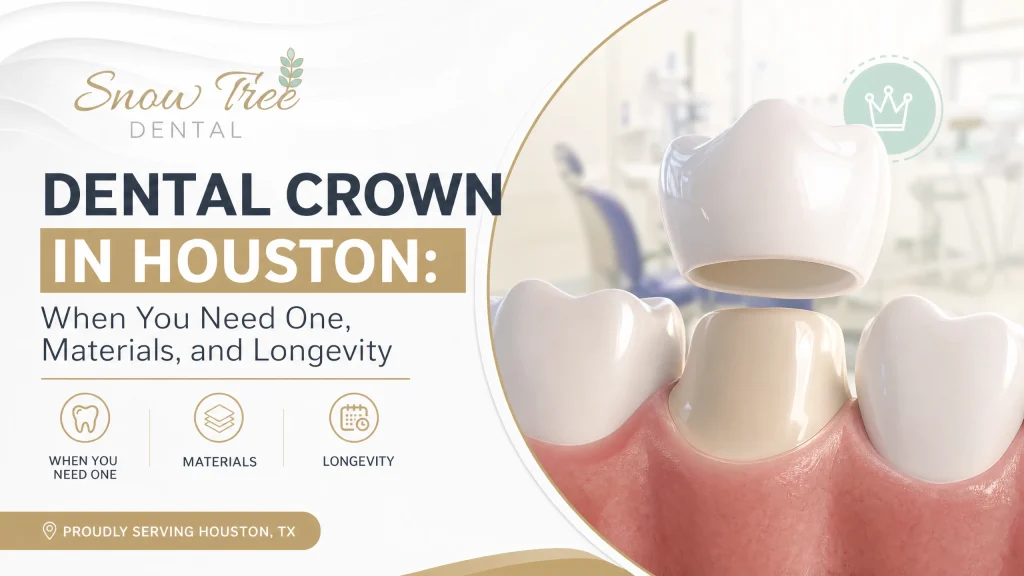
A dental crown in Houston is a custom “tooth cap” that fits over a weakened or damaged tooth to restore its strength, function, and natural appearance.
By covering the tooth, a crown protects the remaining structure from further wear or fracture and lets you bite, chew, and smile comfortably again. Crowns are designed to blend with your smile and are crafted from durable materials chosen for the tooth’s location and your goals.
When You Need a Dental Crown in Houston
Common reasons
- A large cavity or failing filling that can’t be repaired with bonding
- Cracked tooth repair after a fracture or broken cusp
- Severe wear or erosion from grinding or acid
- Added protection after a root canal, especially for back teeth
- To anchor a dental bridge or to restore a dental implant
If your crown need relates to an implant, these guides can help: see our Dental Implants in Houston overview at https://www.snowtreedental.com/?p=3353 and the Dental Implant Process, Healing, and Maintenance at https://www.snowtreedental.com/?p=3357 for step-by-step details.
Signs to watch for
- Pain or sharp discomfort when you bite or chew
- Visible crack lines or a chunk missing from a tooth
- Temperature sensitivity that lingers
- A rough, sharp, or broken edge your tongue keeps finding
If any of these sound familiar, give us a call. We offer same-day emergency support to stabilize the tooth and start planning a long-lasting solution.
Dental Crown Materials: What to Know
Choosing the best crown material depends on where the tooth sits, how much it shows when you smile, and the forces of your bite. (see the American Dental Association’s guide to dental crowns)
Porcelain and ceramic (tooth-colored)
- Excellent aesthetics for front teeth
- Metal-free and generally well tolerated
- Precise shade matching for a natural blend with your smile
Zirconia
- High strength for molars and for patients with heavier bite forces
- Tooth-colored and very durable
- A great option when you need both strength and a natural look
Porcelain-fused-to-metal (PFM)
- Blends strength and appearance
- A durable metal base layered with tooth-colored porcelain
- Over time, a thin metal line may show near the gumline for some smiles
Full gold or metal alloys
- Exceptional longevity and gentle on opposing teeth
- Often allows a more conservative tooth preparation
- Not tooth-colored, so typically reserved for back molars
How to choose in real life
We’ll help you balance:
- Location: Front teeth typically favor lifelike ceramics; molars often benefit from zirconia’s strength.
- Bite forces and grinding: Heavier bites may call for stronger materials and a nightguard.
- Aesthetic goals: How closely should the crown match your neighboring teeth?
- Timeline and comfort: Do you need a quicker turnaround or temporary stabilization today?
- Budget considerations: We’ll discuss materials that fit your goals and coverage without pressure.
How Long Do Dental Crowns Last?
With good care, many crowns last 10–15 years or longer. Longevity depends on the material, your bite and habits, your oral hygiene, and how precisely the crown is designed and fitted.
Factors that influence durability
- Material and placement: Back teeth take higher bite forces.
- Bite/grinding: Clenching or grinding can wear or fracture crowns over time.
- Oral hygiene and gum health: Clean margins help prevent decay where the crown meets the tooth.
- Fit and technique: Accurate impressions or digital scans support proper contacts and a comfortable bite.
- Diet and habits: Frequent hard candies, ice chewing, or very sticky foods can stress a crown.
Maintenance tips for longer life
- Brush twice daily and clean between teeth (floss or a water flosser) to protect crown margins.
- Wear a nightguard if you clench or grind.
- Keep regular checkups and professional cleanings—small adjustments can prevent bigger issues.
- Avoid using your teeth as tools and go easy on very hard or sticky foods.
The Crown Process at Snow Tree Dental
Step-by-step overview
- Evaluation and imaging: We examine the tooth, take digital X-rays, and use our intraoral camera to show you exactly what we see.
- Tooth preparation and impressions/scan: We gently shape the tooth to make room for the crown and take precise impressions or a digital scan for our lab partners.
- Temporary crown care: You’ll leave with a temporary cap to protect your tooth and maintain your bite while the final crown is crafted. Avoid very sticky foods and, when flossing, slide the floss out to prevent loosening the temporary.
- Final crown placement and bite adjustment: At the next visit, we try in your new crown, check the fit and color, and make comfortable bite adjustments before bonding it in place.
Same-Day Emergency Crown Options in Houston
If you chip or break a tooth, we can often see you the same day to stabilize it. We may place a protective temporary, smooth sharp edges, or provide pain-relieving treatment so you can function comfortably while your definitive crown is made. This same-day emergency crown approach lowers the risk of further cracking and helps you avoid chewing on one side for too long.
Crown After Root Canal: Timing and Protection
Back teeth that have had a root canal are more prone to fracture because the inner tooth structure has been cleaned and shaped. A crown after a root canal is commonly recommended—especially for molars—to protect the tooth, restore full strength, and seal out bacteria. We typically provide temporary coverage right away and place the final crown after the tooth settles and any temporary material is removed, based on your specific case and comfort.
Costs, Insurance, and Membership Made Simple
We accept most PPO insurance plans and file claims on your behalf to keep things easy. For patients without insurance, our in-house membership starts at $225/year and includes two exams, two cleanings, fluoride, X-rays, and up to 20% off other services. We’re happy to review your benefits and outline options—no surprises and no pressure.
Our Houston Experience: Gentle, Modern, Family-Friendly Care
One recent afternoon near the Galleria, a patient rushed in with a painful cracked molar right before a big work presentation. We took low-radiation digital X-rays, showed the crack with our intraoral camera, and stabilized the tooth that day. The patient left comfortable with a protective temporary and returned for a final zirconia crown that felt natural on the first bite check. Evening and Saturday hours made the visits easy to fit into a full schedule, and our trilingual team—English, Spanish, and Arabic—kept communication simple. Our practice, led by Dr. Muna Mohammed, focuses on calm, clear communication so every step feels manageable.
Quick Answers You Can Use
- How long do dental crowns last? With good care, many crowns last 10–15 years or longer, depending on material, bite forces, and hygiene.
- Which crown material is best? Front teeth often benefit from porcelain or ceramic for appearance; molars frequently use zirconia for strength. We’ll recommend based on location, bite, and your goals.
- Can I get help today for a broken tooth? Yes—Snow Tree Dental offers same-day emergency appointments in Houston to stabilize the tooth and plan definitive crown treatment.
Myth vs. Fact: Crowns Edition
- Myth: “Once I get a crown, I can’t get a cavity there.”
- Fact: The crown itself won’t decay, but the natural tooth at the edge (the margin) can—daily hygiene and checkups are key.
- Myth: “All crowns look the same.”
- Fact: Materials differ in color, translucency, and strength. We match your case to the right material for a natural look and durable function.
- Myth: “Crowns are always painful.”
- Fact: With modern techniques and numbing, patients are typically comfortable during and after treatment. Mild soreness is usually short-lived.
Practical Temporary Crown Tips
- Chew on the opposite side and avoid very sticky foods (like caramels) until the final crown is placed.
- Brush gently around the temporary; when flossing, slide the floss out instead of pulling up.
- If the temporary loosens, call us—keeping the tooth covered protects your bite and comfort.
Why Houston Patients Choose Snow Tree Dental
- Location and access: Near the Galleria at 2400 Augusta Dr with evening and Saturday appointments.
- Same-day emergency crown care: Get stabilizing treatment fast when cracks or breaks happen.
- Modern tech and comfort: Low-radiation digital X-rays, intraoral cameras, and a calm, family-friendly environment.
- Coverage made easy: Most PPOs accepted; we file claims for you. In-house membership for preventive care and discounts.
- Clear communication: Trilingual team (English, Spanish, Arabic) and a friendly, transparent approach.
Considering Alternatives to a Crown?
Crowns shine when a tooth is significantly compromised. For smaller defects, a filling or an onlay may be enough. If a tooth can’t be predictably restored, an implant with a crown might be considered—explore our Dental Implants in Houston overview at https://www.snowtreedental.com/?p=3353 and our step-by-step guide at https://www.snowtreedental.com/?p=3357 to understand timing and healing. If you’re comparing options like bridges, you may also want to read our crowns vs. bridges in Houston guide, or learn how crowns differ from veneers in our crowns vs. veneers in Houston article at https://www.snowtreedental.com/?p=3364. We’ll review all reasonable paths and recommend what fits your tooth, budget, and timeline.
Frequently Asked Questions
What is a dental crown (tooth cap), and when do I need one?
Short answer: A crown is a custom cover that restores a damaged tooth when a filling won’t suffice—often after a large cavity, crack, heavy wear, or a root canal.
Expanded: A dental crown (tooth cap) fits over a weakened tooth to restore strength, function, and a natural look. Common reasons include a failing large filling, cracked tooth repair, severe wear or erosion, added protection after a root canal (especially on molars), or to anchor a bridge or restore a dental implant.
How long does a dental crown last?
Short answer: With good care, many crowns last 10–15 years or longer.
Expanded: Longevity depends on material, placement, bite/grinding habits, hygiene, and fit. Strong materials like zirconia often serve molars well, while excellent hygiene and regular checkups help protect the crown’s margins from decay.
Which crown material is best for me?
Short answer: Front teeth often favor porcelain/ceramic for appearance; molars often benefit from zirconia for strength.
Expanded: We match material to your tooth’s location, bite forces, and aesthetic goals. Options include porcelain/ceramic (best look), zirconia (high strength), porcelain-fused-to-metal (blend of strength and appearance), and full metal/gold (exceptional durability for back teeth).
Do I need a crown after a root canal?
Short answer: Usually for back teeth—crowns protect and strengthen root canal–treated molars.
Expanded: After a root canal, back teeth are more prone to fracture. A crown after root canal helps prevent cracking, restores full function, and seals the tooth. Timing is based on your case; we typically provide temporary coverage before placing the final crown.
Can I get a same-day emergency crown in Houston if I break a tooth?
Short answer: Yes—Snow Tree Dental offers same-day emergency appointments to stabilize the tooth.
Expanded: If you chip or fracture a tooth, we can often see you the same day to smooth sharp edges, place a protective temporary, and manage pain while your definitive crown is made. Call (832) 464-3368 or book online at https://snowtreedental.com/.
What is the dental crown process at Snow Tree Dental?
Short answer: Evaluation and imaging, gentle prep and impressions/scan, a temporary crown, then final crown placement and bite adjustment.
Expanded: We start with digital X-rays and intraoral photos, prepare the tooth comfortably, take precise impressions or a digital scan, and place a temporary. At the next visit, we try in the final crown, check color/fit, adjust your bite, and bond it in place.
Will getting a crown hurt?
Short answer: Most patients are comfortable—modern numbing and techniques make the process smooth.
Expanded: You may feel pressure or mild, short-lived soreness after treatment, but significant pain is uncommon. If you’re anxious, let us know—we keep care calm and gentle, and we’ll review comfort options before we begin.
How do I care for a temporary crown?
Short answer: Avoid very sticky foods, chew on the other side, brush gently, and slide floss out instead of pulling up.
Expanded: Temporaries protect your tooth and maintain your bite. If one loosens, call us promptly so we can re-cement it—keeping the tooth covered reduces sensitivity and helps ensure the final crown fits properly.
Can a crowned tooth still get a cavity?
Short answer: Yes—at the edge where the crown meets your natural tooth.
Expanded: While the crown material doesn’t decay, plaque can affect the margin. Brush twice daily, clean between teeth, and keep regular checkups to protect those margins and gum health.
What if I grind my teeth—will my crown break?
Short answer: We choose stronger materials (often zirconia) and may recommend a nightguard.
Expanded: Grinding increases forces that can wear or fracture teeth and crowns. A custom nightguard helps protect your investment and your natural teeth. We’ll assess your bite and build the plan around your habits.
How much does a crown cost, and do you take insurance?
Short answer: We accept most PPO insurance and file claims; our in-house membership starts at $225/year and offers up to 20% off other services.
Expanded: Exact crown fees vary by material and case details. We’ll review your benefits, provide a clear estimate, and discuss options without pressure. Our membership includes two exams, two cleanings, fluoride, X-rays, and savings on additional treatment.
Are there alternatives to a crown?
Short answer: Sometimes—small issues may be fixed with a filling or onlay; severely damaged teeth may need an implant with a crown.
Expanded: We’ll recommend the least invasive, predictable option. Explore our Dental Implants in Houston overview at https://www.snowtreedental.com/?p=3353 and step-by-step guide at https://www.snowtreedental.com/?p=3357. For comparisons, see crowns vs. veneers at https://www.snowtreedental.com/?p=3364.
A quick, real practice note from Houston
Short answer: Same-day stabilization helps.
Expanded: Recently near the Galleria, we saw a patient with a cracked molar before a big meeting. Digital X-rays and our intraoral camera showed the fracture, we placed a protective temporary that day, and the final zirconia crown felt natural after a simple bite check—no missed work.
Your Next Step
If you suspect you need a dental crown in Houston—or you’re dealing with a cracked or painful tooth—reach out. Our team at Snow Tree Dental will evaluate your tooth with modern imaging, explain your options clearly, and take great care of you from temporary relief to final crown placement.
Schedule online with our friendly dentist in Houston at https://snowtreedental.com/ or call us at (832) 464-3368. We’re near the Galleria at 2400 Augusta Dr with evening and Saturday appointments. When you’re ready, we’re here to help you get back to eating, smiling, and speaking with confidence—with a well-made dental crown in Houston that feels right at home.