
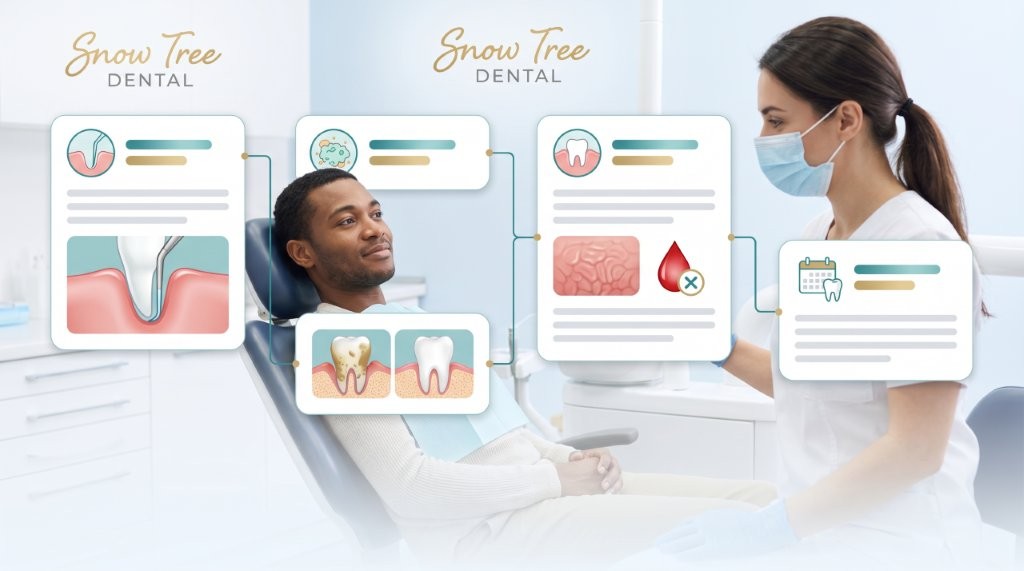
Hearing that you may need a deep cleaning can feel a little unsettling at first. Many patients wonder if it means something painful, serious, or complicated. In reality, deep cleaning is a common gum-focused treatment that helps clean areas a regular dental cleaning cannot fully reach.
At Snow Tree Dental, we often see Houston patients who were told they need a deep cleaning but were not given a clear explanation of what that actually means. That uncertainty can make the recommendation feel bigger and scarier than it needs to be, because apparently dental terminology was designed by people who enjoy making normal things sound dramatic.
This guide explains what deep cleaning is, how it differs from a regular cleaning, why your dentist may recommend it, and what to expect before and after your visit.
What Is Deep Cleaning?
A deep cleaning is a dental treatment that removes plaque and tartar from below the gumline. It is commonly known as scaling and root planing.
A regular dental cleaning focuses mostly on the visible surfaces of your teeth and the area right around the gumline. Deep cleaning goes farther. It reaches around the roots of the teeth, where bacteria, plaque, and hardened tartar can collect inside deeper gum pockets.
This treatment is often recommended when there are signs of gum inflammation, gum disease, or tartar buildup below the gumline. It is not simply a “stronger cleaning.” It is a more targeted type of periodontal care designed for gums that need extra attention.
The American Dental Association guide to scaling and root planing explains that scaling and root planing is a deep cleaning below the gumline used to treat gum disease.
Deep Cleaning vs. Regular Dental Cleaning
Many patients assume deep cleaning is just a longer version of a routine cleaning. That is understandable, but not quite accurate.
Regular Dental Cleaning
A regular cleaning is usually preventive. It removes plaque, tartar, and surface stains from the visible parts of the teeth and near the gumline. It is commonly recommended for patients whose gums are generally healthy.
If your gums are healthy, a routine dental cleaning in Houston may be enough to help maintain your oral health.
Deep Cleaning
A deep cleaning is usually recommended when plaque and tartar have collected below the gumline. It focuses on the deeper areas around the tooth roots and gum pockets.
In simple terms, a regular cleaning helps maintain oral health. A deep cleaning helps address gum problems that may already be developing.
Why Might a Dentist Recommend Deep Cleaning?

Your dentist may recommend deep cleaning when bacteria and tartar have moved below the gumline. This can happen when plaque is not fully removed by brushing, flossing, or routine professional cleanings.
Over time, plaque can harden into tartar. Once tartar forms below the gumline, it cannot be removed with a toothbrush or floss at home. That buildup can irritate the gums and contribute to inflammation.
A dentist may recommend deep cleaning if you have:
- Bleeding gums
- Swollen, red, or tender gums
- Deep gum pockets
- Tartar below the gumline
- Persistent bad breath
- Gum recession
- Signs of early or active gum disease
- Loose-feeling teeth or changes in how your bite feels
Not every patient with bleeding gums needs deep cleaning. Still, bleeding is a sign that your gums should be checked. A dental exam and gum measurements help determine what level of care is right for your situation.
When gum inflammation or deeper pockets are present, your dentist may recommend gum disease treatment based on your exam findings.
What Are Gum Pockets?
Your gums naturally fit around your teeth. The small space between each tooth and the surrounding gum tissue is often called a gum pocket. In healthy gums, these spaces are usually shallow and easier to keep clean.
When the gums become inflamed, the pockets can deepen. Deeper pockets can trap bacteria, plaque, and tartar. Once buildup settles into those areas, brushing and flossing may not reach far enough to remove it.
During an exam, your dental team may measure these pockets using a small dental instrument. These measurements help show whether a regular cleaning is enough or whether deep cleaning may be needed.
This is one reason deep cleaning should not be guessed from symptoms alone. Two patients can both have bleeding gums, but their gum measurements may tell very different stories.
Signs You May Need Deep Cleaning
You may want to schedule a dental evaluation if you notice:
- Your gums bleed when brushing or flossing
- Your gums look puffy, red, or swollen
- You have bad breath that does not improve
- Your teeth feel sensitive near the gumline
- Your gums seem to be pulling away from your teeth
- You see tartar buildup near the gumline
- You have not had a dental cleaning in a long time
- A dentist has told you that you have gum pockets
These signs do not automatically mean you need deep cleaning, but they are worth checking. Gum problems are often easier to manage when they are evaluated early instead of ignored until they become harder to treat, which is unfortunately the human tradition with many health issues.
What Happens During a Deep Cleaning Appointment?
A deep cleaning appointment usually starts with an exam and gum measurements. Your dentist or hygienist may also review X-rays if needed to check bone support and look for tartar buildup below the gumline.
Scaling Below the Gumline
Scaling removes plaque and tartar from the tooth surfaces and below the gumline. Special dental instruments are used to clean areas that a toothbrush or floss cannot reach.
Root Planing
Root planing smooths the root surfaces of the teeth. This helps remove rough areas where bacteria can collect and supports a healthier gum environment.
Numbing and Comfort
Some patients need local numbing during deep cleaning, especially if the gums are tender or the pockets are deeper. Others may need little or no numbing depending on their sensitivity and the amount of buildup.
The treatment may be completed in one visit or divided into sections of the mouth. Your dentist will recommend the approach that fits your gum health, comfort level, and treatment needs.
Does Deep Cleaning Hurt?
Deep cleaning should not feel like something you simply have to survive while staring at the ceiling and regretting every missed flossing session. Patient comfort matters.
Many patients do well with local numbing. You may feel pressure, vibration, or movement during the cleaning, but sharp pain should be communicated right away. Your dental team can pause, check your comfort, and adjust as needed.
After the visit, mild tenderness, gum sensitivity, or tooth sensitivity can happen for a short time. Your dental team should explain what is normal, what to watch for, and how to care for your gums afterward.
What to Expect After Deep Cleaning
After deep cleaning, your gums may feel tender for a little while. Some patients also notice temporary sensitivity to cold foods, brushing, or flossing.
Common aftercare guidance may include:
- Brush gently but consistently
- Floss carefully as instructed
- Avoid aggressive brushing
- Follow any personalized instructions from your dentist
- Keep your follow-up appointment
- Tell your dental team if discomfort, swelling, or bleeding seems unusual
Some patients may be placed on a periodontal maintenance schedule after deep cleaning. This is different from a routine cleaning schedule and is designed to help manage gum health over time.
Good home care also matters. Deep cleaning can remove buildup from deeper areas, but daily brushing, flossing, and follow-up visits help keep those areas healthier afterward.
Real Practice Experience: What Patients Often Ask
In real dental visits, many patients feel nervous when they hear the words “deep cleaning” because they assume it means something severe or painful. Often, the biggest relief comes from simply understanding the gum measurements and seeing why a regular cleaning may not be enough. When patients know where the buildup is and why the gums are inflamed, the treatment usually feels much less mysterious.
That explanation matters. Patients are more likely to follow through with care when they understand the reason behind the recommendation instead of feeling like they were handed a vague dental commandment.
Myth vs. Fact About Deep Cleaning
Myth: Deep cleaning is just an expensive regular cleaning.
Fact: Deep cleaning is different because it targets plaque and tartar below the gumline and around the tooth roots. It is usually recommended when gum health needs more than routine preventive cleaning.
Myth: If my gums bleed, I should stop brushing or flossing.
Fact: Bleeding gums often mean the gums are irritated or inflamed. Gentle brushing and proper flossing are still important, but you should also schedule a dental exam to find out what is causing the bleeding.
Myth: Deep cleaning means my teeth are in terrible shape.
Fact: Not necessarily. Deep cleaning may be recommended to help manage gum inflammation and prevent problems from getting worse. It is a treatment step, not a judgment. Thankfully, teeth do not file complaints about your past habits.
Myth: Once I get deep cleaning, I never need gum care again.
Fact: Deep cleaning is only part of the process. Follow-up visits, home care, and maintenance cleanings may be needed to keep your gums healthier over time.
How Deep Cleaning Supports Gum Health
Deep cleaning helps remove plaque and tartar from areas that regular brushing and routine cleaning cannot fully reach. When bacteria remain below the gumline, they can continue irritating the gums.
By cleaning these deeper areas, deep cleaning supports a healthier gum environment. It may help reduce inflammation and make it easier for patients to maintain their gums with daily home care.
The key is consistency. Deep cleaning is not a magic reset button. It works best when followed by good brushing, flossing or interdental cleaning, and regular dental visits.
Your dentist may also recommend changes to your home-care routine, such as improving brushing technique or using tools that clean more effectively between the teeth. These recommendations should be based on your specific gum condition, not a one-size-fits-all checklist.
Deep Cleaning Houston: Why Local Dental Care Matters
If you are searching for deep cleaning Houston, you may already have symptoms like bleeding gums, bad breath, or tenderness. You may also have been told by another dentist that you have gum pockets and want a clearer explanation before moving forward.
A local dental team can examine your gums, measure pocket depths, review your dental history, and explain whether deep cleaning is truly needed. That personal evaluation matters because gum care should be based on your mouth, not a generic internet checklist pretending to be a dentist.
At Snow Tree Dental, the goal is to make the process understandable. Patients deserve to know what is being recommended, why it matters, and what their options are before they make decisions about treatment.
When to Call a Dentist in Houston
You should contact a dentist Houston patients can rely on if you notice:
- Gums that bleed often
- Swelling or tenderness around the gums
- Bad breath that does not improve
- Gum recession
- Loose-feeling teeth
- Pain when chewing
- A long gap since your last dental cleaning
- A previous recommendation for deep cleaning that you never completed
If symptoms are sudden, severe, or getting worse, do not wait for them to “just go away.” Gums are not known for sending polite reminder emails before problems become more serious.
If you are unsure whether your symptoms need attention, speaking with a dentist in Houston can help you understand the next step.
FAQ About Deep Cleaning
Many patients feel nervous when they hear the words deep cleaning, mostly because they are not sure what makes it different from a regular cleaning. In real dental visits, patients usually feel more comfortable once they understand their gum measurements, where buildup is located, and why the dentist is recommending this type of care. Tiny miracle, really: clear explanations make scary dental words less dramatic.
What is deep cleaning at the dentist?
Short answer: Deep cleaning is a gum-focused dental treatment that removes plaque and tartar from below the gumline.
Expanded answer: Deep cleaning is commonly called scaling and root planing. Unlike a regular dental cleaning, it reaches deeper areas around the tooth roots where plaque and tartar may collect inside gum pockets. A dentist may recommend it when there are signs of gum inflammation, deeper gum pockets, or gum disease.
Is deep cleaning different from a regular dental cleaning?
Short answer: Yes. A regular cleaning focuses on visible tooth surfaces, while deep cleaning reaches below the gumline.
Expanded answer: A regular cleaning is usually preventive and helps maintain healthy teeth and gums. Deep cleaning is more targeted. It is used when buildup has collected below the gumline or when gum measurements show deeper pockets. This is why a dentist may recommend deep cleaning instead of a routine cleaning.
How do I know if I need deep cleaning?
Short answer: You may need deep cleaning if your dentist finds deep gum pockets, tartar below the gumline, or signs of gum disease.
Expanded answer: Common signs that should be checked include bleeding gums, swollen gums, persistent bad breath, gum recession, or tenderness around the gumline. These symptoms do not automatically mean you need deep cleaning, but they do mean a dental exam is important. Your dentist will use gum measurements and an exam to decide what type of cleaning is appropriate.
Does deep cleaning hurt?
Short answer: Deep cleaning is usually manageable, and local numbing may be used for comfort.
Expanded answer: Some patients feel pressure, vibration, or mild tenderness during treatment, but sharp pain should not be ignored. If your gums are sensitive or the cleaning needs to reach deeper pockets, your dental team may use local anesthetic to help keep you comfortable. Afterward, temporary tenderness or sensitivity can happen.
What should I expect after deep cleaning?
Short answer: You may have mild gum tenderness, temporary sensitivity, or light bleeding for a short time.
Expanded answer: After deep cleaning, your gums may feel sensitive when brushing, flossing, or eating cold foods. Your dentist may give you specific home-care instructions and may recommend a follow-up visit or periodontal maintenance depending on your gum health. If discomfort, swelling, or bleeding seems unusual, call your dental office.
Can deep cleaning help bleeding gums?
Short answer: Deep cleaning may help when bleeding is related to plaque, tartar, and gum inflammation below the gumline.
Expanded answer: Bleeding gums can happen for different reasons, so a dentist should evaluate the cause. If bleeding is connected to gum inflammation and buildup below the gumline, deep cleaning may be part of the recommended treatment plan. Better brushing and flossing are also important after treatment.
Can I avoid deep cleaning with better brushing and flossing?
Short answer: Good home care helps, but it cannot remove hardened tartar below the gumline.
Expanded answer: Brushing and flossing are important for preventing plaque buildup, but once plaque hardens into tartar, it needs professional removal. If tartar has collected inside deeper gum pockets, a regular toothbrush cannot reach it. This is when a dentist may recommend deep cleaning.
Why would a Houston dentist recommend deep cleaning?
Short answer: A Houston dentist may recommend deep cleaning if your gum measurements, symptoms, or tartar buildup show that your gums need more than a regular cleaning.
Expanded answer: Patients searching for deep cleaning in Houston are often trying to understand a recommendation they received during an exam. The decision should be based on your actual gum health, including pocket depths, inflammation, buildup, and symptoms. A local dental evaluation helps determine whether deep cleaning is truly needed.
Is deep cleaning the same as scaling and root planing?
Short answer: Yes, in many cases, deep cleaning refers to scaling and root planing.
Expanded answer: Scaling removes plaque and tartar from the tooth surfaces and below the gumline. Root planing smooths the root surfaces to reduce rough areas where bacteria can collect. Together, scaling and root planing are commonly referred to as deep cleaning.
How often do I need deep cleaning?
Short answer: Deep cleaning is not always done on a regular schedule like routine cleanings.
Expanded answer: The need for deep cleaning depends on your gum health. Some patients may only need it when gum disease or deeper pockets are present. Afterward, your dentist may recommend periodontal maintenance visits to help manage gum health over time. Your dental team should explain the schedule that fits your specific condition.
Conclusion: Deep Cleaning Is About Protecting Gum Health
A deep cleaning can sound intimidating, but it is a common dental treatment used when the gums need more attention than a regular cleaning can provide. It helps remove plaque and tartar below the gumline, supports healthier gums, and gives patients a clearer path forward.
If you have bleeding gums, gum tenderness, bad breath, or you were told you may need deep cleaning in Houston, Snow Tree Dental can help you understand what is happening and what care may be right for you.
To schedule a calm, clear gum health evaluation, contact Snow Tree Dental in Houston today.