
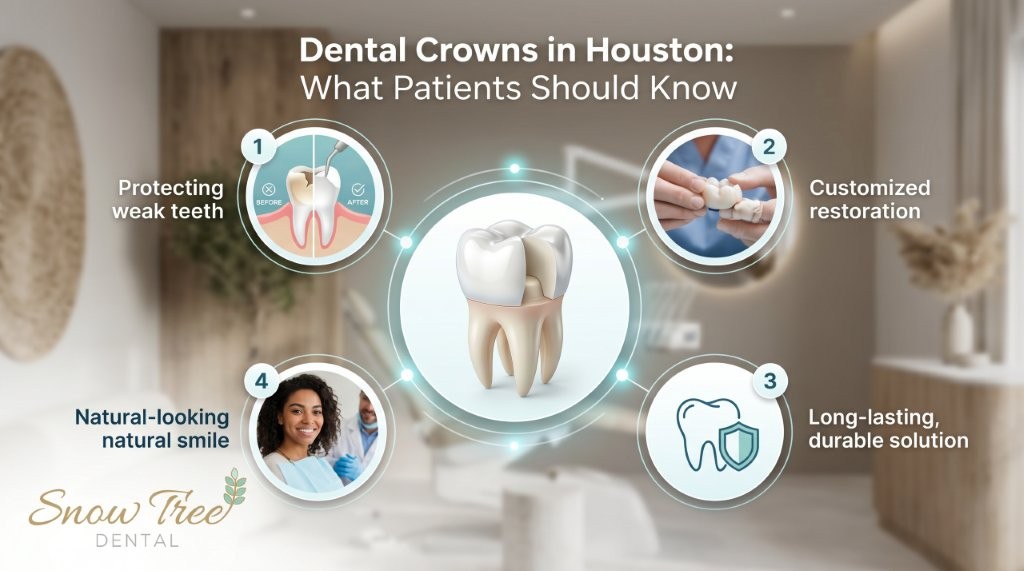
If your dentist has recommended dental crowns, you may have a few immediate questions: Why do I need one? Is a filling not enough? How long does the process take? And, naturally, what will it cost?
Those are fair questions. A crown can feel like a bigger step than a routine filling, especially if the tooth is not causing major pain yet. At Snow Tree Dental, we know Houston patients want clear, practical answers before making treatment decisions.
A dental crown may be recommended when a tooth is too damaged, weak, cracked, worn down, or heavily filled to be restored safely with a filling alone. This guide explains what dental crowns do, when they may be needed, what the treatment process usually involves, what can affect cost, and how to choose a trusted dentist in Houston for your care.
What Are Dental Crowns?
A dental crown is a custom-made cap that covers the visible part of a tooth. It is designed to restore the tooth’s shape, strength, function, and appearance.
Crowns are often used when a tooth needs more support than a filling can provide. For example, a tooth with a large cavity, a fracture, or a large old filling may not have enough healthy structure left to handle daily chewing pressure. In these cases, a crown can help protect what remains of the natural tooth and allow the patient to chew more comfortably.
A crown does not make the natural tooth disappear. The tooth underneath still matters, and it still needs care. The goal is to protect and restore the tooth when it still has a good long-term outlook.
Dental crowns are part of broader restorative dentistry in Houston, especially when a tooth needs more strength and coverage than a filling can provide. For a general patient-friendly explanation, you can also learn more about dental crowns from the ADA.
When Might You Need a Dental Crown?
Your dentist may recommend a crown for several different reasons. The right treatment depends on the condition of the tooth, the amount of healthy structure remaining, your bite, your oral health, and your long-term goals.
A tooth has a large cavity or filling
Small cavities can often be repaired with fillings. But when a cavity is large, or when a tooth already has a large filling, there may not be enough strong tooth structure left to support another filling.
In that situation, placing a larger filling may not give the tooth enough protection. A crown may be a better option because it covers the tooth more fully and helps distribute chewing pressure.
A tooth is cracked, worn, or weakened
Cracked teeth can be tricky. Some cause sharp pain, while others only feel sensitive when biting or releasing pressure. Some cracks are visible, and some are not easy to see without a dental exam.
A dental crown may help protect a cracked or weakened tooth from further damage, depending on where the crack is and how deep it goes. If a crack extends too far, other treatment options may need to be discussed. This is why an exam matters before assuming what the tooth needs.
A tooth has had root canal treatment
After root canal treatment, many back teeth need crowns because they may be more vulnerable to fracture. The crown helps protect the tooth and restore chewing function.
Not every tooth is the same, though. Your dentist should explain why a crown is or is not recommended after root canal treatment based on the tooth’s location, remaining structure, and biting forces.
A crown is needed for a dental implant or bridge
Crowns are also used as the visible replacement tooth on dental implants. If a missing tooth is replaced with an implant, the crown is the part that looks and functions like a tooth.
Crowns can also be part of a dental bridge, which may be used to replace a missing tooth by anchoring to nearby teeth.
A tooth needs cosmetic improvement
In some cases, crowns may improve the appearance of teeth that are severely worn, misshapen, discolored, or damaged. Still, crowns are not always the first cosmetic option.
Depending on the condition of the tooth, treatments such as bonding, veneers, whitening, or other options may be more conservative. A good dentist should explain why a crown makes sense before recommending it for cosmetic reasons.
Types of Dental Crowns Houston Patients May Discuss
Different crown materials may be recommended based on the location of the tooth, how visible it is when you smile, how much pressure it takes when chewing, and your overall treatment goals.
There is no single crown material that is best for every patient. Because every tooth is different, the best crown material is not the same for every patient.
Porcelain or ceramic crowns
Porcelain and ceramic crowns are often chosen for their natural appearance. They can blend well with surrounding teeth and may be especially useful for front teeth or areas where appearance is a major concern.
Zirconia crowns
Zirconia crowns are known for strength and durability. They may be recommended for back teeth or for patients who place heavier pressure on their bite. Depending on the case, zirconia crowns can also be designed to look natural.
Porcelain-fused-to-metal crowns
Porcelain-fused-to-metal crowns combine a metal base with a porcelain outer layer. They have been used for many years and may still be appropriate in certain situations.
Metal crowns
Metal crowns are very strong and may be used in areas where appearance is less important, such as back molars. They are usually not selected for visible front teeth because of their color.
The right crown material depends on function, appearance, tooth location, bite pressure, and your dentist’s clinical recommendation.
How the Dental Crown Process Usually Works
The crown process can vary depending on your tooth, the type of crown being made, and the technology used by the dental office. Many cases, however, follow a similar general path.
Exam and diagnosis
Your dentist will examine the tooth and may take X-rays or photos. This helps determine whether the tooth can be restored, whether decay or cracks are present, and whether any additional treatment is needed first.
This step is important because a crown should not be recommended just because a tooth “looks bad.” The dentist should be able to explain what is happening and why a crown may be the right solution.
Tooth preparation
If a crown is needed, the tooth is shaped so the crown can fit properly. The amount of preparation depends on the tooth’s condition and the material being used.
The goal is to create enough space for the crown while preserving as much healthy tooth structure as possible.
Impression or digital scan
After the tooth is prepared, your dentist will take an impression or digital scan. This information is used to design and create the crown so it fits your tooth, your bite, and the surrounding teeth.
Temporary crown when needed
Some crowns are made by a dental lab and require more than one visit. In those cases, a temporary crown may be placed while the final crown is being made.
Temporary crowns are not as strong as final crowns, so patients usually need to be careful with sticky, chewy, or very hard foods. If a temporary crown feels loose or comes off, it is important to call the dental office.
Final crown placement
At the final visit, the dentist checks the fit, bite, shape, and appearance of the crown before cementing it. Small bite adjustments may be needed so the crown feels comfortable when chewing.
A properly adjusted crown should not feel too high or awkward. If it does, patients should call the office rather than trying to “just live with it.”
What Affects the Cost of Dental Crowns in Houston?
Many patients searching for dental crowns Houston want to know the price first. That makes sense. Dental care is a real expense, and patients deserve clear information before moving forward.
The cost of a dental crown can vary based on several factors:
- The type of crown material
- The location of the tooth
- The complexity of the case
- Whether decay, cracks, or infection are present
- Whether a buildup or root canal treatment is needed
- Lab work and technology involved
- Insurance benefits or payment arrangements
Snow Tree Dental can give you a more accurate cost estimate after examining the tooth and understanding what treatment is actually needed.
A helpful estimate should make the treatment plan clear, including what is included, whether additional care may be needed, and what to expect before starting.
Are Dental Crowns Worth It?
When properly recommended, a dental crown can be an important way to protect a tooth that might otherwise continue to weaken or break. Crowns can help restore chewing ability, protect damaged tooth structure, and improve the appearance of a tooth.
That said, crowns are not magic armor. Their long-term success depends on good oral hygiene, regular dental visits, bite habits, crown material, and the health of the natural tooth underneath.
A crown may be worth it when it helps preserve a tooth that still has a good long-term outlook. If a tooth is too damaged to save, your dentist may discuss other options, such as extraction and replacement.
The key is understanding why the crown is being recommended, not simply accepting treatment because “the tooth needs work.”
Real Practice Experience: What Patients Often Ask
In real dental visits, many patients are not only asking whether they need a crown. They want to know whether the tooth can still be saved, how natural the crown will look, whether the appointment will be uncomfortable, how long the process may take, and what their out-of-pocket cost could be.
A good crown consultation should slow those questions down. Patients should leave understanding the reason for treatment, the available options, and what to expect next. When people understand the “why,” the decision usually feels much less overwhelming.
Myth vs. Fact About Dental Crowns
Myth: A crown means the tooth is fake now.
Fact: A crown covers and protects the natural tooth structure that remains. The tooth underneath still needs brushing, flossing, and regular dental checkups.
Myth: Dental crowns are only cosmetic.
Fact: Some crowns improve appearance, but many are recommended for structural reasons, such as protecting a cracked, weakened, or heavily restored tooth.
Myth: If the tooth does not hurt, it does not need a crown.
Fact: Some damaged teeth do not cause pain right away. A dentist may recommend a crown to help prevent further damage before the tooth becomes painful or harder to restore.
Myth: All crowns are the same.
Fact: Crown materials, appearance, strength, and treatment plans can vary. Your dentist should explain which option makes sense for your specific tooth.
How to Choose a Dentist in Houston for Dental Crowns
Choosing the right dentist in Houston patients can trust is important, especially when treatment involves both health and cost.
Before moving forward with a crown, consider asking:
- Why do I need a crown instead of a filling?
- Is there a crack, large cavity, or weakened area?
- What crown material do you recommend and why?
- Will I need a temporary crown?
- Are there other treatment options?
- What should I expect after the crown is placed?
- What factors affect my cost?
- How should I care for the crown afterward?
A trustworthy dentist should explain the diagnosis clearly and help you understand the reason behind the recommendation. You should not feel rushed, confused, or pressured.
Caring for Your Dental Crown
A dental crown still needs daily care. The crown itself cannot get a cavity, but the natural tooth around the crown can still develop decay or gum problems.
To care for your crown:
- Brush twice daily
- Floss carefully around the crown
- Avoid chewing ice or very hard objects
- Do not use your teeth to open packages
- Wear a nightguard if your dentist recommends one
- Keep regular dental checkups
- Call your dentist if the crown feels loose, high, painful, or uncomfortable
If your bite feels uneven after a crown is placed, do not ignore it. A small adjustment may be needed. If the bite is off, waiting too long may lead to soreness or discomfort.
When Should You Call a Dentist?
Call a dentist if you notice:
- Pain when biting or chewing
- A cracked or broken tooth
- A large old filling that feels loose
- Sensitivity that does not improve
- A crown that feels loose or comes off
- Swelling near the tooth or gum
- A tooth that looks dark, worn, or damaged
- Food constantly getting trapped around an old crown
These symptoms do not always mean you need a crown, but they do mean the tooth should be checked. Early evaluation can often make treatment planning easier and more predictable.
FAQ About Dental Crowns
What are dental crowns?
Short answer: Dental crowns are custom-made caps that cover and protect damaged, weakened, or heavily restored teeth.
Expanded answer: A dental crown fits over the visible part of a tooth to help restore its shape, strength, function, and appearance. Your dentist may recommend a crown when a filling may not provide enough support, especially if the tooth is cracked, worn down, heavily filled, or damaged by decay.
When do I need a dental crown?
Short answer: You may need a dental crown if your tooth is too weak, cracked, damaged, or heavily restored for a filling alone.
Expanded answer: A crown may be recommended when a tooth has a large cavity, a large old filling, a crack, heavy wear, or structural weakness. Crowns may also be used after root canal treatment, as part of a dental bridge, or as the visible replacement tooth on a dental implant. The best way to know if you need one is to have the tooth examined.
How much do dental crowns cost in Houston?
Short answer: The cost of dental crowns in Houston depends on the crown material, tooth location, case complexity, and whether additional treatment is needed.
Expanded answer: There is no one-size-fits-all price for a crown because every tooth is different. Cost can be affected by the type of crown, the condition of the tooth, whether a buildup or root canal is needed, and the details of your treatment plan. Snow Tree Dental can provide a more accurate estimate after examining the tooth and explaining your options.
Are dental crowns painful?
Short answer: Most dental crown procedures are done with local anesthesia to help keep the area comfortable.
Expanded answer: During the procedure, your dentist typically numbs the area before preparing the tooth. Some patients may feel mild soreness or sensitivity afterward, especially around the gumline or when the bite is being adjusted. If pain is severe, lasts longer than expected, or gets worse, you should call your dentist.
How long does it take to get a dental crown?
Short answer: Some dental crowns require more than one visit, depending on the tooth, material, and office process.
Expanded answer: Many crown treatments involve preparing the tooth, taking an impression or digital scan, placing a temporary crown if needed, and then placing the final crown at a later visit. Your dentist can explain the expected timeline based on your specific case and whether the crown is made in-office or by a dental lab.
What type of dental crown is best?
Short answer: The best dental crown depends on the tooth location, bite pressure, appearance goals, and your dentist’s recommendation.
Expanded answer: Porcelain, ceramic, zirconia, porcelain-fused-to-metal, and metal crowns can each be useful in different situations. Front teeth may require a more natural-looking material, while back teeth may need extra strength for chewing. Your dentist should explain why a certain material fits your tooth and your goals.
Can a crowned tooth still get a cavity?
Short answer: Yes, a crowned tooth can still develop decay around the edge of the crown.
Expanded answer: The crown itself does not get a cavity, but the natural tooth underneath and around the crown margin still needs care. Brushing, flossing, and regular dental checkups help protect the tooth and gums around the crown.
What should I do if my crown comes off?
Short answer: Call your dentist as soon as possible if your crown comes off.
Expanded answer: Keep the crown safe, avoid chewing on that side, and do not try to permanently glue it back yourself. A loose or missing crown can leave the tooth more vulnerable to sensitivity, damage, or decay. Your dentist can check the crown and tooth to decide whether it can be recemented or needs another solution.
Is a dental crown better than a filling?
Short answer: A crown is not always better than a filling, but it may be better when the tooth needs more protection.
Expanded answer: Fillings are often used for smaller areas of decay or damage. Crowns may be recommended when a tooth has lost more structure, has a large filling, or needs full coverage for strength. Your dentist should explain why a crown is being recommended instead of a filling.
How do I care for a dental crown?
Short answer: Care for a dental crown by brushing, flossing, avoiding hard objects, and keeping regular dental visits.
Expanded answer: A crown still needs daily care because the tooth and gum around it remain important. Avoid chewing ice, opening packages with your teeth, or ignoring bite discomfort. If you grind your teeth, your dentist may recommend a nightguard to help protect the crown and surrounding teeth.
When should I call a dentist about an old crown?
Short answer: Call a dentist if an old crown feels loose, painful, high, sensitive, or traps food often.
Expanded answer: These symptoms may mean the crown, bite, gum tissue, or tooth underneath needs to be checked. You should also call if the crown cracks, comes off, or if you notice swelling near the tooth. Early evaluation can help avoid bigger problems later.
What should I ask before getting dental crowns in Houston?
Short answer: Ask why the crown is needed, what material is recommended, what affects cost, and what to expect during treatment.
Expanded answer: Before moving forward, it is reasonable to ask whether a filling or another option could work, whether the tooth needs additional treatment first, how the crown will be made, and how to care for it afterward. A good consultation should help you understand the diagnosis and feel comfortable with the plan.
Dental Crowns in Houston: Final Thoughts
Dental crowns can be a practical way to protect damaged, weakened, or heavily restored teeth. When recommended appropriately, they may help restore chewing function, improve tooth appearance, and reduce the risk of further damage.
For Houston patients, the most important step is getting a clear diagnosis. You should understand why the crown is being recommended, what material may be used, what the process involves, and what factors may affect your cost.
If you think you may need a crown, or if another dentist has told you a tooth needs one, Snow Tree Dental can help you understand your options clearly. Schedule a visit with our Houston dental team for a personalized consultation and treatment plan.