
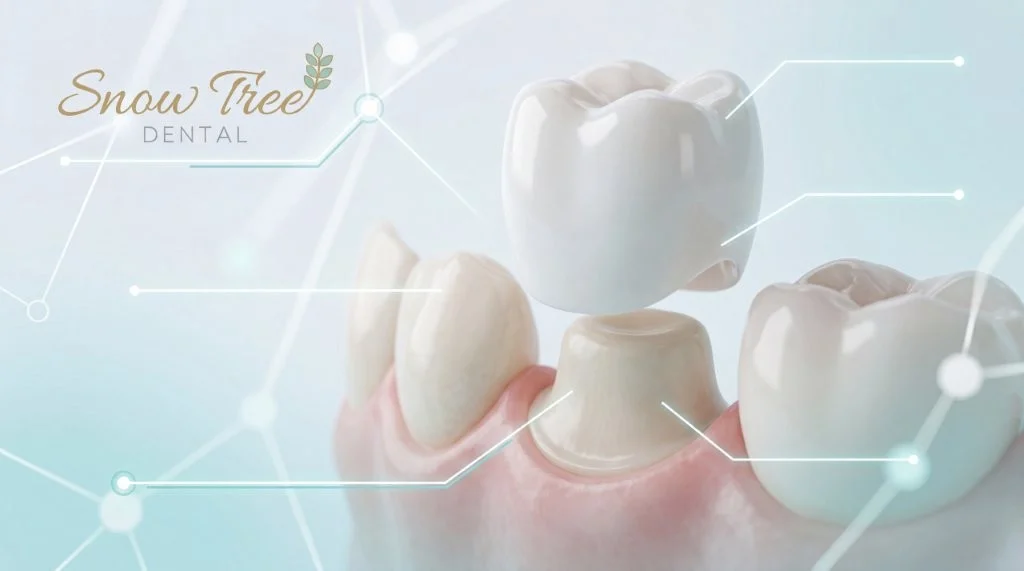
Dealing with a damaged or severely painful tooth is a mechanical problem that requires a precise structural solution. When a tooth is compromised by advanced decay or physical trauma, ignoring the issue inevitably leads to worsening conditions, including root infections or the complete loss of the tooth. For structural stabilization, dental crowns remain the most reliable method to salvage a tooth that can no longer support a standard filling.
If you are evaluating treatment options and looking for a capable dentist in Houston, understanding the mechanics of the procedure is your first step. This guide outlines the function of a crown, the clinical indicators that require one, the materials used, and the exact process you can expect at Snow Tree Dental.
What Are Dental Crowns?
A dental crown is a custom-fabricated prosthetic cap designed to fit precisely over a weakened or damaged tooth. Once permanently cemented, the crown completely encases the visible portion of the natural tooth that sits above the gum line. This essentially replaces the damaged enamel with a durable synthetic exterior, restoring the tooth’s structural integrity, shape, and mechanical function.
When a tooth loses a significant percentage of its mass to a cavity or a fracture, it can no longer safely bear the immense compressive forces generated by the human jaw. A crown redistributes that mechanical load. Instead of the force splitting the remaining fragile tooth walls, the crown absorbs and disperses the pressure safely.
Modern dental crowns are not off-the-shelf products. They are engineered to match the exact topography of your bite and the shade of your adjacent teeth, ensuring the restoration functions correctly within the complex biomechanics of your jaw.
Clinical Indicators: When You Need a Dental Crown
Standard fillings are effective for minor to moderate decay. However, there are specific clinical scenarios where a filling will fail, and a crown becomes the mandatory standard of care.
Severe Decay and Compromised Enamel
When a cavity expands too far, the volume of healthy enamel left behind is insufficient to hold a large filling. Placing a massive composite filling into a hollowed-out molar turns the filling into a wedge. Under the heavy force your jaw exerts during chewing, that wedge will eventually split the remaining thin tooth walls. A crown binds the tooth together from the outside, absorbing and dispersing the mechanical load safely.
Fractured, Broken, or Severely Worn Teeth
Teeth fracture due to acute physical trauma or chronic mechanical stress, such as biting on ice or unmanaged nocturnal teeth grinding (bruxism). Bruxism, in particular, can grind teeth down to flat, highly sensitive stumps, exposing the underlying dentin. Crowns rebuild the vertical height of the tooth and shield the exposed nerve endings from thermal and physical stimuli.
Structural Protection Following a Root Canal
When the internal nerve of a tooth becomes infected, a root canal treatment is often required to clear the infection and save the tooth. However, removing the nerve leaves the tooth brittle and highly prone to shattering. Capping a root-canaled tooth—especially load-bearing molars—with a dental crown is a critical step to ensure the tooth remains functional for the long term.
Engineering the Restoration: Crown Materials
The choice of material dictates the durability, aesthetic outcome, and longevity of the restoration. Your dentist will recommend a material based on the location of the tooth and your specific bite forces.
- Zirconia Crowns: Zirconia (zirconium dioxide) is a crystalline oxide of zirconium. It is exceptionally strong, fracture-resistant, and tooth-colored. It is the preferred choice for back molars that endure heavy chewing forces but where aesthetics still matter.
- Porcelain and Ceramic Crowns: These offer the highest level of aesthetic realism. Modern ceramics replicate the light-handling properties and slight translucency of natural enamel. They are typically reserved for front teeth where cosmetic blending is the primary concern.
- Porcelain-Fused-to-Metal (PFM): PFM crowns utilize an underlying metal alloy shell overlaid with baked porcelain. They offer excellent strength, though a dark line may eventually become visible at the gum margin if the tissue recedes over time.
- Gold Alloys: While aesthetically poor for visible teeth, gold alloys are the gold standard for mechanical durability. They will not fracture, they wear down at the exact same rate as natural enamel, and they are highly biocompatible. They are an optimal, pragmatic choice for out-of-sight second molars.
The Procedure: Getting Dental Crowns in Houston
The fabrication and placement of a crown is a precision process that typically spans two appointments. At Snow Tree Dental, we integrate modern technology to streamline this workflow.
Phase 1: Diagnostics and Tooth Preparation
The process initiates with digital radiography to verify the bone health and root structure beneath the tooth. Once cleared for a crown, we administer local anesthesia to ensure the procedure is entirely painless.
The tooth must be physically modified to accommodate the thickness of the crown. We systematically remove any decayed tissue and reduce the circumference and height of the tooth. Once the structural preparation is complete, we capture the exact geometry of the prepared tooth.
Phase 2: Digital Impressions and Laboratory Fabrication
Instead of using traditional, uncomfortable alginate putty, we frequently utilize intraoral digital scanners. This technology captures thousands of images per second, rendering a highly accurate 3D mesh model of your teeth. This digital file is instantly transmitted to a specialized dental laboratory, where CAD/CAM (Computer-Aided Design and Computer-Aided Manufacturing) technology is used to mill or press your custom crown with micron-level precision.
Phase 3: The Temporary Crown Experience
Because laboratory fabrication requires approximately one to two weeks, you will receive a temporary acrylic crown to protect the prepared tooth.
In our Houston practice, we know patients often dread the “temporary crown” phase due to past experiences with bulky, poorly fitted acrylics that alter their bite. We take this phase seriously. We use precise baseline impressions to ensure your temporary crown mimics your natural tooth closely. It will maintain your proper bite alignment, protect the underlying dentin from temperature shocks, and keep the adjacent teeth from shifting while we wait for the permanent restoration. While you must avoid sticky or aggressively hard foods, the temporary should feel stable and functional.
Phase 4: Final Placement and Occlusal Adjustment
During your second visit, we remove the temporary cap and clean the underlying tooth. The permanent crown is seated, and we rigorously check the marginal fit (where the crown meets the tooth) and the interproximal contacts (how it touches neighboring teeth). We use articulating paper to map your bite and ensure the crown does not interfere with your natural occlusion. Once verified, it is permanently bonded into place using dental cement.
Separating Myth from Fact
Myth: The crown procedure is inherently painful.
Fact: With current local anesthetics, tooth preparation is no more uncomfortable than a routine filling. Any post-operative tissue inflammation is typically minor and manages well with standard over-the-counter anti-inflammatories.
Myth: A crowned tooth is immune to future decay.
Fact: The synthetic crown cannot decay, but the biological tooth structure beneath it absolutely can. The margin where the crown meets the root is vulnerable. If bacterial plaque accumulates there, secondary decay can form and undermine the entire restoration.
Maintenance and Longevity
Dental crowns represent a significant investment in your oral infrastructure. Maximizing their lifespan requires basic maintenance.
- Mechanical Protection: Do not use your teeth as tools. Opening packaging or biting fingernails applies unnatural shear forces that can fracture ceramic restorations.
- Nightguards for Bruxism: If you grind your teeth, a custom-fitted occlusal guard is non-negotiable. Chronic grinding will eventually shatter even the strongest zirconia crown.
- Consistent Hygiene: Brush twice daily and floss to clear the margins around the crown.
- Clinical Monitoring: Regular professional cleanings allow us to check the integrity of the cement seal and monitor for marginal decay.
Frequently Asked Questions
1. How long do dental crowns actually last?
Short Answer: Most dental crowns last 10 to 15 years under normal conditions.
Expanded Answer: With strict oral hygiene and routine clinical monitoring, a crown can last a decade or longer. Conversely, chewing ice, using your teeth as tools, or leaving bruxism (teeth grinding) untreated will fracture the material prematurely and necessitate a costly replacement.
2. Is getting a crown a painful process?
Short Answer: No. The tooth and surrounding tissues are completely anesthetized during preparation.
Expanded Answer: We use targeted local anesthetics to eliminate pain during the structural reduction of the tooth. Minor tissue inflammation may occur for 24 to 48 hours afterward as the gums adapt to the new margins, which responds predictably to standard over-the-counter anti-inflammatory medication.
3. Can a tooth with a crown still get a cavity?
Short Answer: Yes. The natural tooth structure beneath the crown remains highly vulnerable to decay.
Expanded Answer: The ceramic or zirconia material itself cannot decay, but bacterial plaque easily accumulates at the margin where the crown meets your gum line. If decay undermines this margin, the entire crown will fail. Daily brushing and flossing are non-negotiable for maintaining the restoration.
4. Why is a temporary crown necessary?
Short Answer: It protects the exposed, highly sensitive tooth structure while the dental laboratory mills your permanent restoration.
Expanded Answer: The temporary crown seals the exposed dentin against temperature shocks and prevents neighboring teeth from shifting into the open space. In our Houston practice, patients often expect the temporary phase to be clumsy or painful. We ensure the baseline impressions are exact so your temporary crown actually fits, seals the tooth properly, and stabilizes your bite, rather than functioning as a bulky placeholder that falls off during dinner.
5. What should I do if my crown falls off?
Short Answer: Secure the crown and contact our clinic immediately. Do not attempt to glue it yourself.
Expanded Answer: Decementation occurs due to underlying decay or the mechanical shear stress of excessively sticky foods. Never use household adhesives to reattach it; doing so destroys the restoration and can poison the tooth. If the underlying root remains intact, we can often professionally clean and re-cement the original crown.
6. Are dental crowns covered by insurance?
Short Answer: Coverage varies, but medically necessary crowns are typically partially covered by most dental plans.
Expanded Answer: If a crown is placed to resolve advanced decay or a structural fracture, insurance usually subsidizes a percentage of the procedure. Crowns requested purely for cosmetic reasons are generally excluded. We advise verifying your specific policy limitations and waiting periods directly with your provider before authorizing treatment.
7. Is a crown better than a large filling?
Short Answer: Yes. A crown provides critical structural reinforcement that a large filling cannot offer.
Expanded Answer: Placing a massive composite filling into a hollowed-out molar turns the filling into a wedge. Under the heavy force your jaw exerts during chewing, that wedge will eventually split the remaining thin tooth walls. A crown binds the tooth together from the outside, absorbing and dispersing the mechanical load safely.
8. Do dental crowns look fake?
Short Answer: Not if they are engineered correctly using modern ceramics or zirconia.
Expanded Answer: High-grade porcelain and zirconia are precisely color-matched and contoured to replicate the light-handling properties of your adjacent natural enamel. Unless you opt for a functional gold alloy crown for an out-of-sight back molar, the final restoration will integrate seamlessly with your natural bite.
9. Are there alternatives if I do not want a crown?
Short Answer: If a tooth lacks structural integrity, the only functional alternative is usually an extraction.
Expanded Answer: Delaying treatment out of avoidance does not freeze the damage in place. If a crown is medically prescribed, a localized onlay might suffice in borderline cases. Otherwise, the compromised tooth will eventually shatter or become infected, leaving extraction followed by a dental implant or a fixed bridge as your only remaining options. To learn more about standard guidelines on restorative materials and procedures, you can read the clinical recommendations from the American Dental Association.
Conclusion: Take the Next Step Toward Structural Stabilization
Ignoring a structurally compromised tooth is a temporary delay that leads to more invasive and expensive procedures. Dental crowns are the proven, definitive solution to halt degradation and restore both the mechanical function and appearance of your teeth.
At Snow Tree Dental, we prioritize precision, clinical transparency, and patient comfort. We leverage modern dental technology to ensure your restorations are accurate, durable, and indistinguishable from natural teeth. If you require a crown or need a second opinion regarding a damaged tooth, schedule a consultation with our Houston team today to review your diagnostics and secure your oral health.