
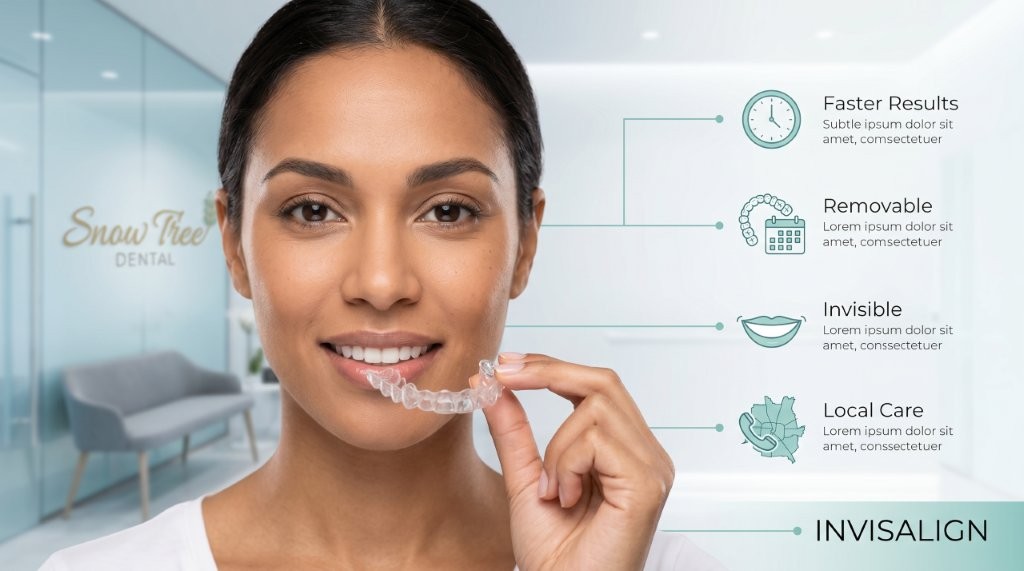
If you are thinking about Invisalign, you may be looking for a way to straighten your teeth without the look or feel of traditional braces. That is a very common reason patients ask about clear aligners. Invisalign is discreet, removable, and often easier to work into everyday life, which makes it appealing for adults, teens, and busy families.
For patients in Houston, Invisalign can be a helpful option for improving certain tooth alignment, spacing, and bite concerns. Still, it is not the right treatment for every person or every smile. Before starting, it is important to understand how Invisalign works, what daily life with aligners is like, and what your dentist needs to evaluate.
At Snow Tree Dental, our goal is to help patients make informed decisions with clear guidance, realistic expectations, and a treatment plan that fits their oral health needs.
What Is Invisalign?
Invisalign is a clear aligner system that uses a series of removable trays to gradually guide teeth into better alignment. Each set of aligners is made to fit your mouth at a specific stage of treatment and apply gentle, controlled pressure to selected teeth.
Unlike traditional braces, Invisalign does not use brackets or wires. The aligners are clear, smooth, and removable, which is one of the main reasons many patients ask about them. They can be taken out for eating, brushing, and flossing, which may make daily care feel more manageable compared with fixed braces. You can also learn more about clear aligners from the American Association of Orthodontists.
In most cases, Invisalign treatment includes:
- A dental evaluation
- Digital scans, impressions, photos, or X-rays when needed
- A customized treatment plan
- A series of aligners worn in order
- Progress checks with your dentist
- Retainers after treatment to help maintain the result
The exact plan depends on your teeth, gums, bite, and goals. Two patients may both ask for Invisalign, but their treatment needs can be very different. Teeth, as it turns out, refuse to follow a one-size-fits-all marketing brochure. Very inconsiderate of them.
Invisalign vs. Traditional Braces

Both Invisalign and traditional braces are designed to move teeth into better alignment. The main difference is how they do that.
Traditional braces use brackets and wires that stay attached to the teeth during treatment. Invisalign uses removable clear trays that are changed in sequence as the teeth move. For many patients, this difference matters because Invisalign may feel easier to manage during meals, brushing, flossing, work, school, photos, and social events.
That said, braces may still be the better option for some complex orthodontic cases. Invisalign may work well for many mild to moderate alignment concerns, but severe bite problems, significant rotations, or more advanced tooth movement may need a different approach. In some cases, your dentist may recommend a consultation with an orthodontic specialist.
This is why a proper evaluation matters. Clear aligners can be very helpful, but they are not magic. The best treatment is the one that fits your actual dental needs, not just the one that sounds most convenient.
Who May Be a Good Candidate for Invisalign?
Many patients consider Invisalign because they want a less noticeable way to improve their smile. A good candidate usually has healthy teeth and gums and wants to correct alignment concerns that can reasonably be treated with clear aligners.
Patients who are exploring Invisalign may also want to learn about other cosmetic dentistry options that can improve the appearance of their smile.
Common reasons patients ask about Invisalign include:
- Crowded teeth
- Small gaps between teeth
- Mild to moderate spacing concerns
- Teeth that shifted after past orthodontic treatment
- Cosmetic alignment concerns
- Certain bite issues, depending on severity
A good Invisalign candidate also needs to be consistent. Aligners must be worn as directed for treatment to stay on track. If the trays spend more time in a purse, cup holder, desk drawer, or restaurant napkin than in your mouth, progress may slow down or become less predictable. The aligners are removable, yes. They are not decorative pocket accessories, despite humanity’s ongoing experiments.
When Invisalign May Not Be the Best Choice
Invisalign is not recommended for every patient or every dental situation. Before starting treatment, your dentist needs to look at your full oral health, not only the position of your front teeth.
Invisalign may not be the best option if you have:
- Untreated cavities
- Active gum disease
- Severe bite problems
- Complex tooth movement needs
- Poor oral hygiene habits
- Difficulty wearing aligners consistently
- Dental concerns that should be treated first
If there are cavities, gum inflammation, worn teeth, or other dental issues, those may need attention before clear aligner treatment begins. Starting with general dental care in Houston may create a healthier foundation before clear aligner treatment. Moving teeth in an unhealthy mouth is rarely the smart first step. It may be better to stabilize your oral health first, then revisit Invisalign once your teeth and gums are ready.
What to Expect During an Invisalign Consultation in Houston
If you are considering Invisalign Houston treatment, the first step is usually a consultation. This visit helps your dentist determine whether clear aligners are a good fit for your smile, your bite, and your overall dental health.
If you are unsure whether clear aligners are right for you, you can schedule a dental consultation in Houston with Snow Tree Dental to review your teeth, bite, and smile goals.
During the consultation, your dentist may:
- Examine your teeth and gums
- Evaluate your bite
- Discuss your smile goals
- Ask about past orthodontic treatment
- Review any discomfort or dental concerns
- Take photos, X-rays, scans, or impressions if needed
- Explain whether Invisalign may be appropriate
- Discuss realistic treatment expectations
This is also the right time to ask practical questions. Patients often want to know how aligners affect eating, speech, meetings, travel, school, photos, and daily routines. These questions are not minor details. They often determine whether treatment feels realistic and manageable.
A good consultation should leave you with a clear understanding of your options, not a rushed sales pitch. You should know why Invisalign is being recommended, what limitations may apply, and what your role will be during treatment.
Real Practice Experience: What Patients Usually Ask First
In real dental conversations, many patients are not only asking whether Invisalign can straighten their teeth. They want to know whether the trays will be noticeable, whether they can eat normally, whether speech will feel different, and whether they will realistically remember to wear the aligners every day.
Those practical concerns matter. A treatment plan can look excellent clinically, but if it does not fit a patient’s daily life, it becomes harder to follow. That is why habits, comfort, expectations, and lifestyle should be part of the Invisalign conversation from the beginning.
What Daily Life With Invisalign Is Like
One of the biggest reasons patients like Invisalign is that the aligners are removable. You take them out to eat and to drink anything other than water. This usually means fewer food restrictions compared with traditional braces.
Still, removable does not mean optional. Your dentist will explain how often and how long you should wear your aligners based on your treatment plan. Consistent wear is one of the most important parts of getting the best possible result from clear aligners.
Eating and Drinking
With Invisalign, you remove the aligners before meals. This helps protect the trays and keeps food from getting trapped between the aligners and your teeth.
Basic habits usually include:
- Remove aligners before eating
- Drink water while wearing aligners
- Avoid hot drinks while trays are in place
- Brush before putting aligners back in when possible
- Store aligners in their case instead of wrapping them in a napkin
The napkin rule deserves special attention. Many aligners have disappeared because someone wrapped them up at lunch and forgot about them. They then made the short, tragic journey from table to trash can. It is a tiny dental disaster, but somehow still very common.
Cleaning Your Teeth and Aligners
Good oral hygiene is especially important during Invisalign treatment. Since the aligners fit closely over your teeth, you do not want food particles, plaque, or sugary residue trapped underneath them.
Helpful habits include:
- Brush at least twice daily
- Floss daily
- Clean aligners as instructed
- Rinse trays before reinserting them
- Keep regular dental checkups
- Call your dentist if trays crack, feel sharp, or stop fitting properly
Your dentist may give you specific cleaning instructions based on your treatment plan. Some patients need extra guidance if they are prone to plaque buildup, gum inflammation, dry mouth, or cavities. The goal is to move teeth while keeping the mouth healthy throughout treatment.
Comfort and Speech
Some patients feel pressure or tightness when they start Invisalign or switch to a new set of aligners. This can be expected because the trays are designed to guide tooth movement. The sensation often improves as your mouth adjusts.
You may also notice a slight change in speech at first. For many patients, this improves with practice as the tongue adjusts to the trays. Reading out loud for a few minutes can sometimes help you adapt more quickly, although your family may briefly wonder why you have become dramatically committed to dental homework.
If discomfort feels severe, if an aligner is cutting your gums, or if something does not feel right, call your dental office. Do not try to force a tray into place or ignore ongoing pain.
Benefits Patients Often Like About Invisalign
Patients often ask about Invisalign because it can fit naturally into daily life. The aligners are clear, removable, and designed to be less noticeable than traditional braces.
Common benefits include:
- Clear appearance
- Removable trays
- Easier brushing and flossing compared with fixed braces
- No brackets or wires
- More flexibility during meals
- A treatment option that may work well for adults and teens
For many patients, the biggest benefit is confidence. They can go to work, school, events, and social gatherings without feeling as aware of orthodontic treatment. Invisalign may also make oral hygiene easier than fixed braces because there are no brackets or wires to clean around.
Even with these advantages, results vary from person to person. Invisalign should be recommended based on your dental needs, not only because clear aligners sound convenient.
Important Limitations to Understand
Invisalign has many appealing features, but patients should understand the responsibilities before starting.
Important limitations include:
- Aligners must be worn consistently
- Treatment may take longer if trays are not worn as directed
- Some cases need attachments
- Some patients may need refinements
- Lost or damaged aligners can delay progress
- Not every bite problem can be corrected with Invisalign
- Retainers are usually needed after treatment
Attachments are small tooth-colored shapes that may be placed on certain teeth to help aligners grip and move them more effectively. Not every patient needs them, but they are common enough that patients should understand they may be part of the process.
Refinements may also be recommended in some cases. This means additional aligners may be used to fine-tune the result. Refinements are not necessarily a sign that something went wrong. Sometimes they are part of making treatment more precise.
Myth vs. Fact: Invisalign
Myth: Invisalign works for everyone.
Fact: Invisalign can help many patients, but not every case is a good fit. Your bite, tooth position, gum health, and treatment goals all matter.
Myth: Since aligners are removable, wear time is not a big deal.
Fact: Consistent wear is one of the most important parts of treatment. Removing trays too often can affect progress and may extend treatment time.
Myth: Invisalign means no discomfort at all.
Fact: Some pressure or tightness can happen, especially when switching to a new set of aligners. Severe pain, sharp edges, or ongoing irritation should be checked by your dentist.
Myth: Once treatment is done, teeth stay straight forever.
Fact: Teeth can shift over time. Retainers are commonly recommended after orthodontic treatment to help maintain alignment.
Invisalign in Houston: Why Local Dental Guidance Matters
Choosing a local provider matters because Invisalign is not just about receiving trays. It involves diagnosis, planning, monitoring, and support throughout treatment.
A dentist Houston patients trust can help identify dental concerns before treatment begins. For example, gum inflammation, cavities, worn teeth, or bite problems may affect the timing or type of treatment recommended. Addressing those concerns first can help create a healthier foundation for clear aligner treatment.
Local care also makes follow-up easier. If an aligner does not fit, if attachments come loose, or if you have questions, it helps to have a dental team nearby. Trying to solve everything through guesswork or online forums is not ideal. The internet has many opinions. Your mouth only has one set of teeth.
Questions to Ask Before Starting Invisalign
Before beginning treatment, ask your dentist clear questions so you know what to expect. A thoughtful conversation can help prevent confusion later.
Good questions include:
- Am I a good candidate for Invisalign?
- Do I need dental treatment before starting?
- What concerns do you see with my bite?
- How often will I need checkups?
- Will I need attachments?
- What should I do if I lose an aligner?
- What happens if a tray does not fit?
- Will I need refinements?
- Will I need retainers after treatment?
- What should I know about costs before beginning?
These questions help you understand both the benefits and the responsibilities of treatment. They also help your dentist explain whether Invisalign is the most appropriate option or whether another treatment may better fit your needs.
Is Invisalign Right for You?
Invisalign can be a good option for many patients who want a clear, removable way to improve tooth alignment. It may be especially appealing if you want flexibility during meals, easier brushing and flossing, and a less noticeable alternative to traditional braces.
The right choice, however, depends on your mouth, not just the idea of clear aligners. Your dentist should evaluate your teeth, gums, bite, oral health, and goals before recommending treatment.
If you are considering Invisalign in Houston, Snow Tree Dental can help you understand your options, answer your questions, and determine whether clear aligner treatment is a good fit for your smile.
If you are considering Invisalign in Houston, Snow Tree Dental can evaluate your teeth, bite, and goals and help you understand whether clear aligner treatment is right for you. Schedule a consultation to get clear, personalized guidance before starting treatment.
FAQ: Invisalign in Houston
1. What is Invisalign?
Short answer: Invisalign is a clear aligner treatment that gradually moves teeth using removable trays.
Expanded answer: Invisalign uses a series of clear, custom-made aligners that fit over your teeth. Each set of trays is designed to guide specific tooth movements over time. Many patients like Invisalign because the aligners are discreet and removable, but treatment still requires a dental evaluation, consistent wear, and follow-up care.
2. How do I know if I am a good candidate for Invisalign?
Short answer: You need a dental evaluation to know if Invisalign is right for you.
Expanded answer: A dentist will check your teeth, gums, bite, and smile goals before recommending Invisalign. Clear aligners may be appropriate for certain spacing, crowding, and mild to moderate alignment concerns. If you have untreated cavities, active gum problems, or more complex bite issues, those may need to be addressed first.
3. Is Invisalign better than braces?
Short answer: Invisalign may be better for some patients, while braces may be better for others.
Expanded answer: Invisalign is clear, removable, and often easier to manage during meals and oral hygiene. Traditional braces may be more appropriate for complex orthodontic needs or cases that require more advanced tooth movement. The best choice depends on your bite, tooth position, oral health, and treatment goals. Dentistry, annoyingly enough, still refuses to be one-size-fits-all.
4. Does Invisalign hurt?
Short answer: Invisalign may cause pressure or tightness, especially when switching to a new set of aligners.
Expanded answer: Some pressure is expected because the aligners are guiding your teeth into new positions. This feeling often improves as your mouth adjusts. If pain feels severe, an aligner feels sharp, or irritation does not improve, you should contact your dentist instead of forcing the tray or ignoring the problem.
5. Can I eat with Invisalign?
Short answer: No, you should remove Invisalign aligners before eating.
Expanded answer: Removing your aligners before meals helps protect the trays and keeps food from getting trapped between the aligners and your teeth. Water is usually the safest drink while aligners are in place. After eating, brushing before putting the aligners back in is ideal when possible.
6. How often do I need to wear Invisalign aligners?
Short answer: Invisalign aligners need to be worn consistently according to your dentist’s instructions.
Expanded answer: Consistent wear is one of the most important parts of clear aligner treatment. If aligners are removed too often or left out for long periods, treatment may not progress as planned. Your dentist will explain the recommended wear schedule for your specific case.
7. What happens if I lose an Invisalign aligner?
Short answer: Call your dental office for guidance before switching trays.
Expanded answer: If you lose an aligner, do not guess whether to move to the next tray, go back to the previous one, or stop wearing aligners. Your dentist can tell you the safest next step based on your treatment plan. Also, please use the case. Napkins have claimed enough innocent aligners already.
8. Do I need a retainer after Invisalign?
Short answer: Many patients need retainers after Invisalign to help maintain their results.
Expanded answer: Teeth can shift after orthodontic treatment, so retainers are commonly recommended to help hold the teeth in their new position. Your dentist will explain what type of retainer routine is appropriate for your case after treatment is complete.
9. Can adults get Invisalign?
Short answer: Yes, many adults can be considered for Invisalign.
Expanded answer: Adults often ask about Invisalign because they want a less noticeable way to improve tooth alignment. Candidacy depends on oral health, gum condition, bite concerns, and the type of movement needed. A consultation can help determine whether clear aligners are realistic for your smile.
10. What should I expect at an Invisalign consultation in Houston?
Short answer: Your dentist will evaluate your teeth, gums, bite, and goals to see whether Invisalign is appropriate.
Expanded answer: During an Invisalign consultation in Houston, your dentist may examine your mouth, discuss your smile goals, review dental concerns, and take photos, X-rays, scans, or impressions if needed. The visit should help you understand whether Invisalign fits your needs and what your next steps may look like.
11. Can Invisalign fix gaps or crowded teeth?
Short answer: Invisalign may help with some gaps and crowded teeth, depending on the case.
Expanded answer: Clear aligners can be used for certain spacing and crowding concerns, but not every case is suitable. The amount of movement needed, your bite, and your overall oral health all matter. A dentist can evaluate whether Invisalign is a good option or whether another treatment would be more appropriate.
12. When should I call my dentist during Invisalign treatment?
Short answer: Call your dentist if an aligner does not fit, breaks, feels sharp, causes ongoing irritation, or if you lose a tray.
Expanded answer: Small adjustments and questions are normal during Invisalign treatment. You should contact your dental office if something feels wrong, if an attachment comes loose, if a tray cracks, or if you are unsure what to do next. Local dental guidance can help keep treatment on track and prevent small issues from becoming bigger annoyances, because apparently teeth enjoy creating admin work.
Practice Experience Note
In everyday dental conversations, patients often ask very practical Invisalign questions before they ask clinical ones. They want to know if they can eat normally, whether the trays will affect speech, what happens if they forget to wear them, and whether treatment will fit into work, school, and family routines. Those real-life concerns are important because Invisalign success depends not only on the treatment plan, but also on how well the plan fits the patient’s daily habits.